
Krugman Is Wrong
America doesn't need deMAGAfication, it needs truth and reconciliation


Given that Donald Trump’s approval rating among republications is holding steady at somewhere between 60-80%, Paul Krugman’s call for “deMAGAfication” is nothing less than a call for a second Civil War. Worse, his argument rests on the pernicious myth that Allied “reeducation” (war crimes trials and denazification) transformed the Nazi dictatorship into a constitutional democracy. This claim does not hold up to historical analysis.
After the unconditional surrender of Nazi Germany in 1945, Allied leaders had something extremely rare in international politics—a monopoly on military and political power. For the first time since Napoleon, German soil was occupied by foreign armies. While the citizens of the Third Reich were resigned to having their cities bombed, POWs executed, and territory plundered, the Allied reform and reeducation policies were another matter. Although this was unlike anything Europeans had ever seen, it was familiar to Americans south of the Mason-Dixon Line, who had undergone a similarly resented effort after the Civil War.
The German reeducation programs were founded on the assumption that if the Allies could somberly present evidence of Hitler’s war guilt, Germans would recognize and acknowledge the criminality of their leadership. The centerpiece of this effort were the thirteen international and American war crimes trials held in Nuremberg between 1945-1949. This effort was unsuccessful. “The Nuremberg prosecution, well supplied with documentary evidence, succeeded in refuting these nonsensical excuses and winning convictions,” wrote German historian Jörg Friedrich. “However, the public was not won over.”
When Nuremberg’s International Military Tribunal handed down their decisions in 1946, the German public was hardly “reeducated.” “The Germans learned from posters on the street that their former leaders had been hanged at Nuremberg,” wrote Friedrich. “Now people crowded around the pillars on which the posters hung, reading in silence that ministers, field marshals and police chiefs had also died. There were no signs of remorse. In Wuppertal, schoolgirls dressed in black on the morning of the execution; in Hamburg, people whispered that the British leaders responsible for the bombing of the city also deserved to hang.”
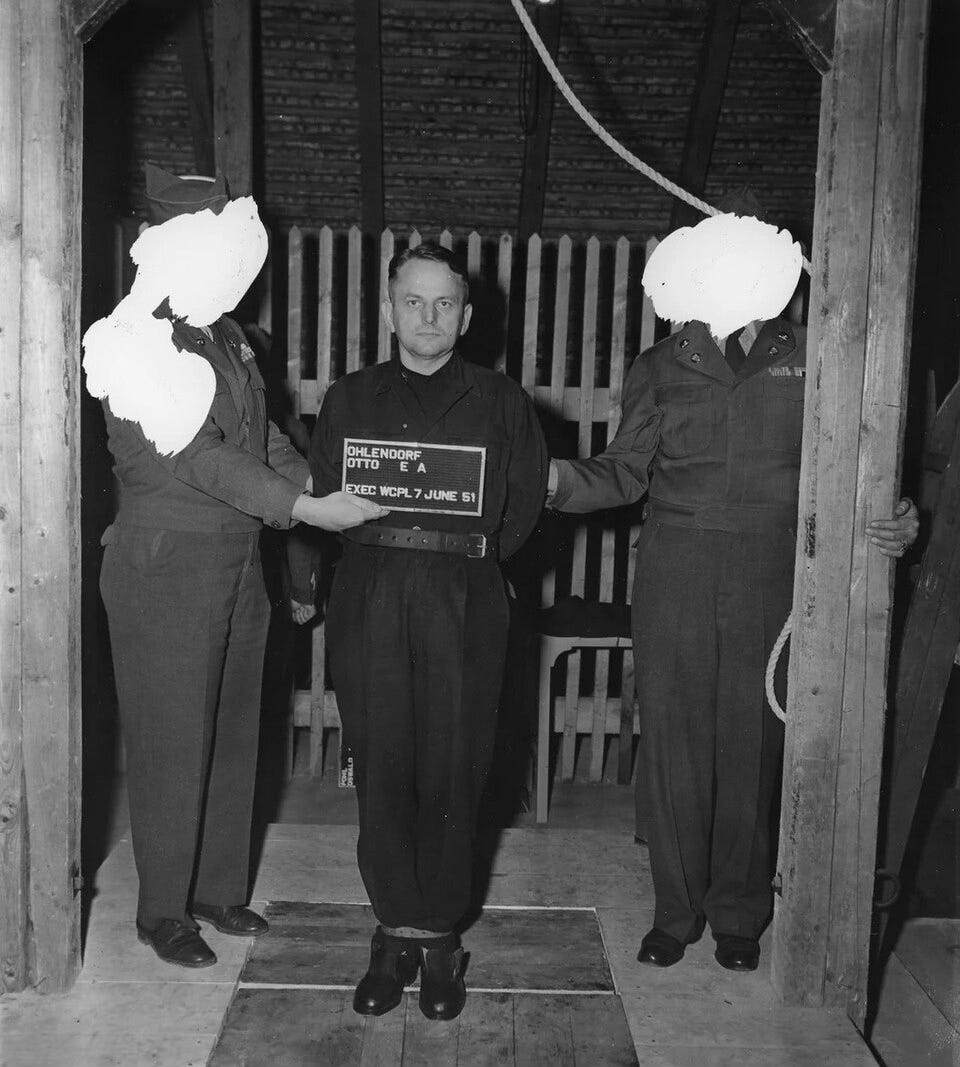
The final execution of Nazi war criminals occurred in 1951. At the funeral of Einsatzgruppen leader Otto Ohlendorf, representatives from all of Germany’s right-wing parties attended. When the casket was lowered into the grave, the mourners gave the Nazi salute. According to Friedrich, “The public uproar over the hanging of these blood tainted butchers underlined Nuremberg’s failure.” In the end, the criminal guilt that the trial planners hoped would serve as “a wedge between the public and the defendants turned out to form a link between them.”
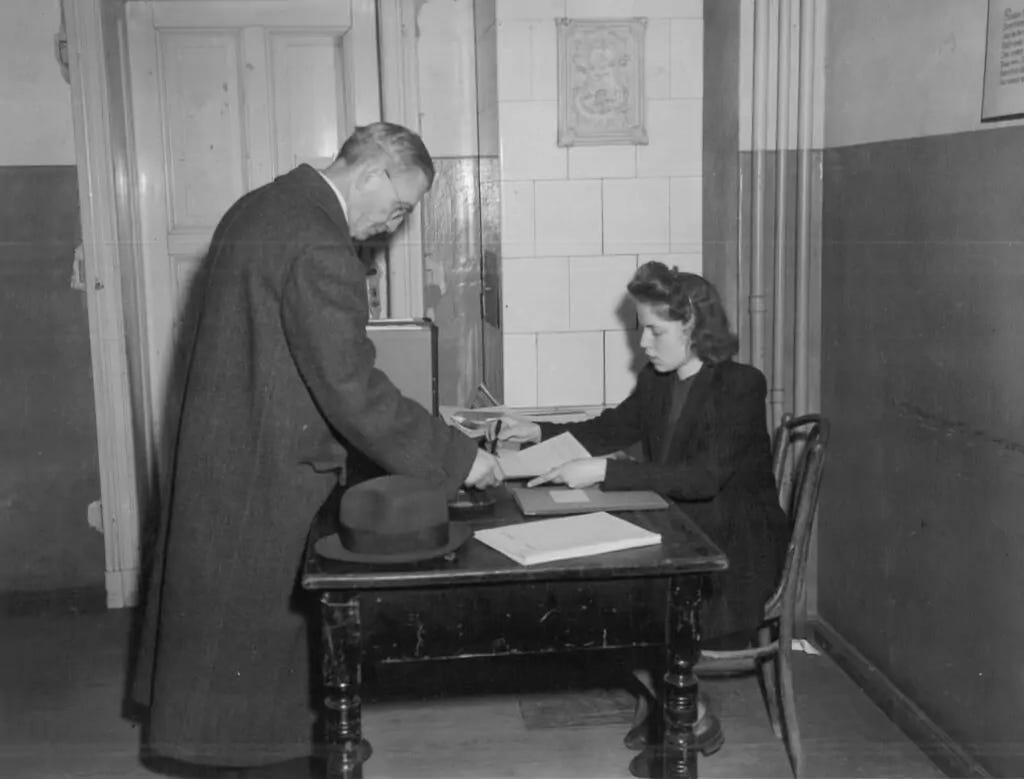
Although the Nuremberg trials were the highest-profile legal proceeding, the vast majority of cases in post war Germany were tried by Allied denazification courts. In early 1946, Allied De-Nazification Law established four levels of offenses for the members of the recently criminalized Nazi organizations. The implications of this vague commitment were both radical and enormous: a large percentage of the German population would have to be processed judicially. More than 13 million Germans registered with denazification boards; 945,000 were tried by denazification courts, and 130,000 were found guilty under some category of law. However, penalties were not very severe; sentences ranged from ineligibility to hold public office to restricted employment, fines, and at worst, forced labor.
Less than a year into the program, due to the Cold War’s international political exigencies, the reeducation plan began to unravel. According to Peter Grose’s book Operation Rollback, “By the summer of 1946, Washington’s top military intelligence officers had abandoned the fervor of deNazification and were arranging for ex-Nazis with ‘special’ qualifications, such as expertise in rocket science and other high technology, to be excused from the indignities of prisoner-of-war status and join the service of the United States for the demands of the postwar era.”
In 1946, the U.S. Allies turned the program over to the German zonal government. Although denazification proceedings continued until 1949, they often appeared farcical under German administration. “Some of the denazification trials were absolutely shocking mockeries,” said former Assistant U.S. High Commissioner for Germany Benjamin Buttenweiser. “They were by no test a complete success….Many . . .withdrew in sullen resentment, a ready audience for the irresponsible demagogy of unreconstructed Nazi leaders.” In his book Beyond Eagle and Swastika, Kurt Tauber wrote, “Most serious of all, the very excesses of denazification procedure not only unjustly discredited the entire idea in the eyes of a large segment of the population but also created a climate of opinion which the Nazis could use for their own purposes.”
In its annual assessment of U.S. foreign policy, the State Department’s Policy Planning Staff (headed by George Kennan) argued that America’s reform and reeducation efforts in Germany had failed. The 1948 “Review of Current Trends in American Foreign Policy” declared: “we must recognize the bankruptcy of our moral influence on the Germans, and we must make plans for the earliest possible termination of those actions and policies on our part which have been psychologically unfortunate.” The report singled out the reeducation efforts: “We must terminate as rapidly as possible those forms of activity (denazification, reeducation, and above all the Nuremberg Trials) which tend to set us up as mentors and judges over internal German problems.” Columbia University laws of war professor Jonathan Bush put it best, “[Nuremberg] was the complete failure of what we would today call civic society, a reeducation in democracy. . . . West Germany . . . is the classic example of peace—and more than that, peace, prosperity, security, good foreign relations, and all that—without justice”
The United States has been in a cold civil war since Donald Trump’s 2016 election. Over the course of the past decade, both republicans and democrats have acted unconstitutionally and regrettably. Donald Trump is not an anomaly. After 9/11, the United States, in the words of Secretary of State John Quincy Adams, went abroad “in search of monsters to destroy.” Instead, we destroyed ourselves.
In 2024, I wrote “America Needs A Truth and Reconciliation Commission” because I believed our criminal justice system had grown too politicized to do anything but create more martyrs. Moreover, because neither party holds a monopoly on political or military power, a Truth and Reconciliation Commission (TRC) is one of the few effective remedies available to a bitterly and dangerously divided nation.
A Truth and Reconciliation Commission should be part of a larger reckoning that forces America to open our national closet, face our past, then ask what we have become and where we are going as a nation. Rather than gallows and primitive political justice, our political, financial, and foreign policy miscreants should get a choice. They can trade testimony for amnesty or face a military tribunal and a life sentence without the possibility of parole.
After the TRC and trials conclude, there should be a third Constitutional Convention that includes national referendums on basic issues: borders, citizenship, free speech, healthcare, pollution, law enforcement, taxes, lobbyists, monopoly/crony capitalism, AI, foreign policy alliances/entanglements, and more. Yes, my idea sounds almost as Polyanna-ish as Krugman’s, but what other options do we have? After all, the bloodiest war in U.S. history was the Civil War. If we could kill 700,000 of each other with single shot rifled muskets, bayonets and primitive artillery, imagine what Palantir could do.