
The Red Queen Resigns
Astrid Tuminez's Uncertain Legacy at Utah Valley University

This week, embattled Utah Valley University (UVU) President Astrid Tuminez announced that she would be stepping down in May. While the UVU PR flacks did a masterful job spinning her resignation into a feel-good story about a woman of color rising from Philippine poverty to the pinnacle of the neoliberal power—Harvard, MIT, Carnegie Corporation, AIG, U.S Institute of Peace, World Economic Forum, Council on Foreign Relations, and Microsoft—her most lasting legacy at UVU was conspicuously absent.
Recently, Astrid Tuminez has gone to great pains to make the point that “her legacy is not Charlie Kirk.” She is correct and should be best remembered for The Tuminez Tribunal, the most biased, one-sided, and unprofessional investigation I have read in my thirty years as a professor, former college trustee and legal investigator. Instigated by her nephew, this academic star chamber court did not end with a verdict, but the suicide of UVU anatomy professor Michael Shively.
On November 24, 2025, I called on Utah senators, congressmen, and education officials to fire Astrid Tuminez and to investigate the UVU President and her henchwomen—assistant Provost Kat Brown, biology professor Sara Flood, and former UVU general counsel Karen Clemes—for their well-documented abuses of power at the university. Below is my original 2021 story about the Tuminez Tribunal, The Red Queens Rules, my articles about Ann Shively v. Utah Valley University, Astrid S. Tuminez, Karen Clemes, and Sara J. Flood, and my 2025 letter to Utah officials calling for Tuminez’s ouster and an investigation of her abuse of power at UVU.
The Red Queen’s Rules:
The Tuminez Tribunal and the Anti Socratic Revolution in American Education
SEP 08, 2021
Over the past two decades, I have witnessed a seismic, anti-Socratic shift in American education. Put simply, many universities cannot afford to upset their students. Although tuitions have tripled since 1975, many institutions of higher learning, backed by non-default student loans, engaged in financial speculation. Often operating on lines of credit, many schools balance their books by relying on exorbitant fees and underpaid labor. In order to keep their student/customers happy, academic administrators weaponized the power of complaint for their increasingly frail student bodies. “It’s astounding how aggressive students’ assertions of vulnerability have gotten in the past few years. Emotional discomfort is regarded as equivalent to material injury, and all injuries have to be remediated,” wrote feminist film professor Laura Kipnis, “Most academics I know — this includes feminists, progressives, minorities, and those who identify as gay or queer — now live in fear of some classroom incident spiraling into professional disaster.” The story you are about to read, is about unaccountable academic administrators who see colleges and universities as self-esteem builders where “student success” is guaranteed and the student/customer is always right. What they fail to realize is that success must first be earned, and is meritless if mandated.
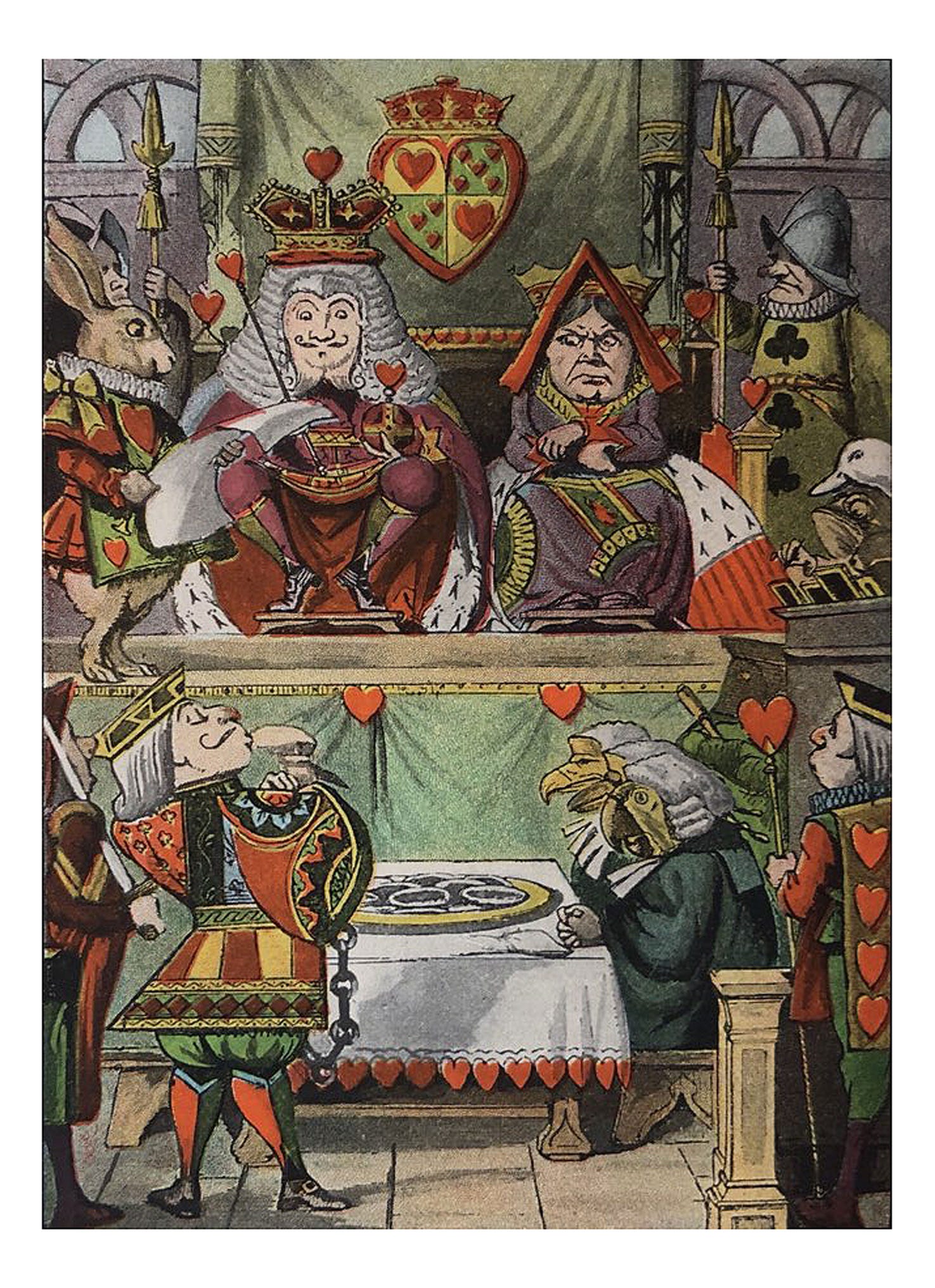
“Let the jury consider their verdict,” the King said, for about the twentieth time that day.
“No, no!” said the Queen. “Sentence first—verdict afterwards.”
—Alice’s Adventures in Wonderland by Lewis Carroll
This month, the U.S. Court of Appeals for the 10th District will hear a case brought by the estate of Utah Valley University (UVU) professor Michael Shively. It alleges that the university’s President, Astrid Tuminez, former general counsel Karen Clemes, and Sara Flood, an Australian who currently teaches in the Department of Biology, conspired to destroy Shively’s career and drove him to suicide. Unless the appellate court intervenes, UVU’s unchecked behavior will set a troubling precedent for 21st-century American higher education. Due process protections will no longer extend to the academic help.[1]
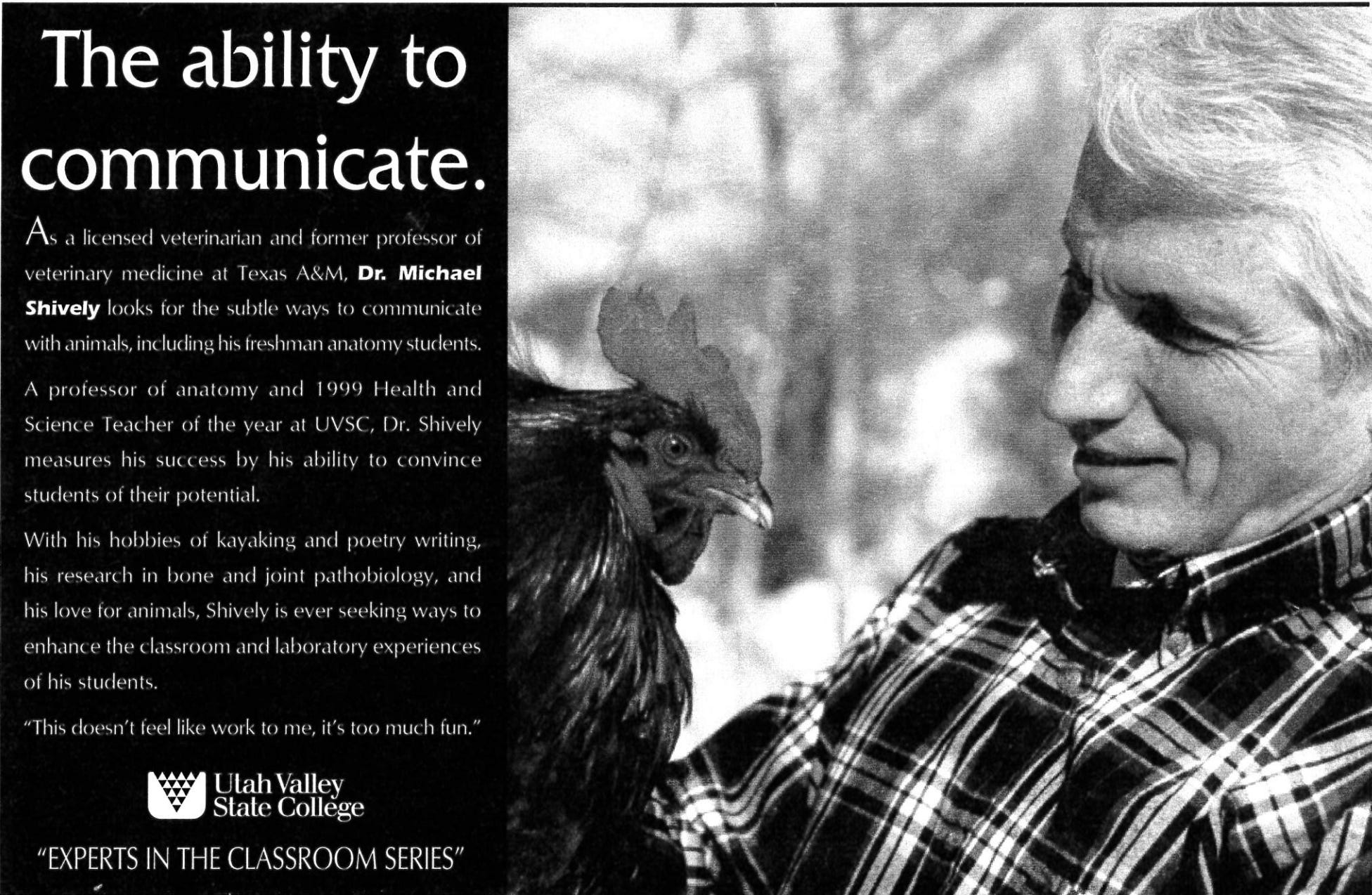
Michael Shively taught anatomy at Utah Valley University for twenty-seven years. During his career at UVU, he was named teacher of the year five times, received nine teaching excellence awards, served as President of the Faculty Senate, was featured in the university’s “Experts in the Classroom Series” on public television. He did not have a single disciplinary incident in his career. His problems began on February 27, 2019, when Kathren “Kat” Brown, the university’s Associate Vice President of Academic Administration, received an email from a male undergraduate identified only as “Student 1.” He charged that Shively’s course placed “unfair demands” on students because he monopolized “so much student time.” Student 1 also charged that the anatomy professor used “tests to gratify his ego by making questions almost impossibly difficult” and that Shively’s textbook contained transphobic language. There was only one problem: Student 1 had never been Michael Shively’s student.[2]

This email complaint was the first shot in an academic coup orchestrated by Student 1’s professor, Sara Flood, in her effort to take over the anatomy program that Shively had built during his long career at Utah Valley University. Although Michael Shively supported the Australian professor’s hiring in 2015 and even helped her get tenure in 2018, by 2019 she wanted her rival fired. Earlier in February, Flood told Marshall Walker, her paid teaching assistant, who had failed Shively’s class, to collect student complaints about Shively because she had a meeting with “one of the heads of UVU” and needed “specific stories about how anatomy with Dr. Shively has affected them emotionally and physically.”Walker sent the following email to students on February 21, 2019: “There is currently a review on Dr. Shively being done on how he runs the program. This is a great opportunity for you to express how anatomy has effected [sic] your life decision on your major, how ridiculous his tests, ELAs were, etc.” Walker urged students to email him “asap” because he had to “turn this information into [sic] the UVU president by Wednesday.”[3]
Why would Astrid Tuminez, the president of a large public university, and a former executive at Microsoft Asia, involve herself in a faculty squabble? Biology professor Jim Harris, and other members of the UVU faculty who are unwilling to go on the record due to fear of retribution, allege that Student 1 was Astrid Tuminez’s nephew (President Tuminez’s spokesperson would neither confirm nor deny this fact). Harris told investigative journalist Steve Murphy, “I was a little shocked by the aggressiveness of one of the student accusers who was also the ringleader, and happened to be a nephew of the president of the institution.”[4]
In the weeks after Walker sent out his email to students, the university received a number of suspiciously similar complaints about Shively, his class, and the difficulty of his exams. Even though the overwhelming majority of those making the charges were Sara Flood’s students, Utah Valley University opened a formal investigation of Michael Shively for five possibly career-ending violations of the university’s code of conduct on March 8. The investigators would look into Shively’s behavior toward students and colleagues, his failure to use a computer message board, royalties he received from his textbook, and his alleged refusal to grant Sara Flood her academic freedom.[5]
As if it were not enough that President Astrid Tuminez’s nephew was leading the charge against this tenured professor, when Sara Flood sat down with President Tuminez and university administrators, she dramatically escalated this conflict. In an academic climate in which the perceptions of comfort and safety are sacrosanct, Flood told them that Shively had threatened and intimidated her and that she feared for her physical safety around him. Flood offered no evidence to back her claims, but she knew that even an unfounded allegation of potential violence required the university to take immediate disciplinary action.[6]
When Michael Shively returned to his office after teaching on March 25, university police intercepted him, took his office keys, escorted him to his car, and told him that he had to stay off campus because he was charged “with a serious offense affecting the public interest.” After the university’s administration ordered Shively not to communicate with faculty or students, he wrote President Tuminez and asked for an explanation for his “mentally traumatic and emotionally wrenching” public ostracism.[7]
President Tuminez never responded to her university’s five-time teacher of the year and former head of the faculty senate because the Tuminez Tribunal, her academic Star Chamber court, was already in session. Instead of Shively’s peers, the Tuminez Tribunal was composed of academic bureaucrat Kat Brown, UVU general counsel Karen Clemes, and an outside hired gun named Spencer Phillips whose management-friendly law firm, Employer–Lawyer LLC, according to its own website, specializes in “defending against employee complaints.”
Over the next three months, UVU investigators interviewed students and professors about Michael Shively, his exams, and his conduct in and out of class. Of the fourteen students who spoke to the Tuminez Tribunal, eleven were students of Sara Flood and only two had actually taken Michael Shively’s anatomy class. According to the “preponderance of the evidence” standard used by the Tuminez Tribunal, the burden of proof was met when there was a greater than 50% chance that an allegation was true.[8]
Tuminez’s nephew, Student 1, was the first witness to speak to the Tuminez Tribunal and told investigators that he was “the spokesperson for disaffected students.” He told the investigators that he had “pieced together” the case against Shively without talking to “Dr. Flood about this directly.” While he did not consider Shively “an out and out male chauvinist, at the very least it is clear [Dr. Shively] is carrying the prejudices and attitudes born of someone born in the 1940s. He is either unwilling or unable to adapt to the outlook and needs of contemporary women.” However, when pressed by investigators, it became clear to the Tuminez Tribunal that “Student 1 relied heavily on hearsay as the basis for most of his concerns. The only complaints he made based on his own experience were Dr. Shively’s use of the word “pathetic.”[9]
Next came a parade of student witnesses who made suspiciously similar complaints about the difficulty of Shively’s exams. Student 2 recalled Flood announcing to the class that “all the tests…were written by Dr. Shively.” Student 3 complained about the hard exams and added, “It was hard to hear from Dr. Flood every day about how ‘no one in the world does it this way, but that’s how Dr. Shively does it.’” Student 4 called the class she had never attended “academic abuse” because it “adds a lot of stress.” Student 5 initially audited Flood’s class because it was “way too hard,” but took it “for reals” the next semester. “I love her. She was awesome,” declared Student 6, before adding that Flood “told us multiple times that he [Dr. Shively] had written the tests.”[10]
Student 7, one of the few students who had taken Michael Shively’s class, called his tests “really hard.” He said that students “need to know [their] anatomy in order to be successful in the course,” and added that Shively had “technology phobia.” Student 7 met with Sara Flood before his second meeting with the Tuminez Tribunal and told them that Flood had “become ‘more and more negative’ in her feelings toward Dr. Shively.” Most significantly, he said that Flood’s “goal of ‘run[ning] the anatomy program’ may not be achieved if he is allowed to return to the University.’”[11]
Student 8, Flood’s teaching assistant Marshall Walker, called Shively “condescending” and “controlling,” and believed this made Flood feel “handcuffed” like she was “walking on eggshells.” Walker “also confirmed that he heard Dr. Flood, on numerous occasions, respond[ed] to student concerns by blaming Dr. Shively for the difficult exam questions.” Students 9, 10, and 12–14, all Flood’s students, made now-familiar complaints about difficult exams and hard grading. Student 11 contacted the investigators when she heard about the investigation because she felt that the campaign against Shively was “nothing more than a witch hunt.”[12]
Tuminez’s nephew, Student 1, didn’t just encourage students to complain about Michael Shively, he also visited faculty members and encouraged them to support Sara Flood’s crusade – or else. After he met with Associate Dean Jason Slack, he followed up with an email summarizing their thirty-minute conversation, and demanded a written response. Not only did he give Slack a deadline, Student 1 warned that “he would take his concerns to Dr. Kathren Brown and the University’s Title IX office if he found Mr. Slack’s response to be ‘absent or unsatisfactory.’”[13]
Student 1 also met with Jim Price, the head of the biology department, and made his now standard complaints about exam difficulty, and then added that “all of the faculty hate [Dr.] Shively.” When Price asked Tuminez’s nephew if he wanted to transfer out of his class, he gave Price “a strange look and said he was already in [Dr. Flood’s] section.” The professor asked why he was complaining. “Because [Dr.] Shively writes the exams,” he replied.[14]
After this strange conversation, Price reached out to Flood to get her side of the Shively story. “Dr. Price and Dr. Flood spoke for about 45 minutes by phone, discussing the concerns raised by Student 1,” wrote the Tuminez Tribunal in their final report. “Near the end of the conversation, Dr. Price recalled asking Dr. Flood, ‘Is everything okay with you and [Dr.] Shively?’ to which Flood replied, ‘Oh, yes, we are great.’” Jim Price asked Sara Flood if Shively was allowing her to write her own exam questions, she said that there was just a misunderstanding over a note that he had written her. When Price asked to see the note, “Flood said that she could not find it.” Nonetheless, Jim Price took the Australian at her word, and left the meeting believing “that the concerns raised by Student 1 were not generally shared by Dr. Flood.” Two days after his meeting with Flood, Jim Price received an email from Student 1 inaccurately describing the substance of their meeting. “Due to the aggressive and authoritative tone of Student 1’s letter,” wrote the Tuminez Tribunal, “Dr. Price sought guidance and advice of several peers before responding in a professional manner and inviting Student 1 to seek further assistance with his concerns by contacting the University’s Ombudsman and Title IX office.”[15]
Even though Michael Shively did not know everything he had been accused of, or even who his accusers were, the Tuminez Tribunal demanded interviews with him. After his first interrogation, Shively asked Scott Abbott, UVU’s American Association of University Professors representative, to accompany him. “This morning, at his request, I accompanied Professor S. to the second meeting he has had with you after his suspension,” wrote Abbott. “Although he was told in the last meeting that he could bring an advisor – either a colleague or legal counsel to the meeting this morning – he and I were told that UVU’s general counsel, consulted while I waited, said that no representative was allowed in this meeting.” Abbott charged UVU’s general counsel, Karen Clemes, with violating university policy.[16]
Although Shively dealt with the investigators in good faith, Scott Abbott now worried that Shively was answering questions without knowing the scope of the investigation. Abbott knew that in an academic star chamber court like this one, anything the professor said could and would be held against him. “I do not believe that the anonymous complaints that we reviewed on 4/17 came from students registered in my class. I have much warmer relationships with my own students than I heard,” Michael Shively wrote investigator Spencer Phillips on March 16, “I was unfairly portrayed to her students as dishonest and deceitful.” In an effort to resolve the conflict, Shively even offered to make his exams easier, “It is my sincere belief that nearly all of the complaints about me and my testing will dissipate if I test with less rigor (easier tests). I sincerely hope that I am given an opportunity to prove this to be true. Thank you for meeting with me today.”[17]
The faculty witnesses who spoke to the Tuminez Tribunal painted a far more nuanced portrait that undermined Sara Flood’s most serious accusations. Don Homan, a lecturer and lab manager who had taught anatomy at UVU for twenty years, debunked Flood’s charge that Shively wrote her exams. Homan said that all three of them “participated in the exam writing process” and added that “Dr. Flood seemed ‘overwhelmed’ by family issues and she ‘sometimes asked to be left out because of other issues she was dealing with.’”[18]
Former biology department chair Virginia Bayer told investigators that she had advised Sara Flood to teach her class “however you want.” Physiology professor Heather Wilson-Ashworth told investigators that Flood complained she felt “constrained and controlled by Dr. Shively.” Wilson-Ashworth said that she never feared for her physical safety around Shively, but she did describe him as “controlling and aggressive toward her (i.e., academic bullying), and that he only backed down because of her willingness to push back and stand up for herself.” When Wilson-Ashworth told Flood to tell the department chair about her problem, Flood refused and said, “Things are fine, things are fine. [Dr. Shively] is helping me with my visa.”[19]
Biology professor Jim Price flatly rejected the Tuminez Tribunal’s assumption that Sara Flood was the victim in this case and instead told them that “[Dr. Shively] is a victim of a hostile work environment [created] by [Dr.] Flood.” According to Price, the Australian’s biggest problem was that she was “afraid of students,” so she pandered to them. “[She’s] not able to tell them anatomy is hard and we need future patients to be in good hands,” Price explained to the investigators. “I think she says things in class to deflect responsibility for the difficulty of the class onto [Dr. Shively], and then the students complain.” Price also told the investigators that he was growing increasingly “worried” about Michael Shively.[20]
Sara Flood’s turn came to testify on May 2 and she was forced to acknowledge that Michael Shively had supported her throughout her career at UVU and “that her constant finger-pointing ‘caused problems’ for Shively.” Still, Flood made her boldest claim yet and told the Tuminez Tribunal that “she is worried about Dr. Shively shooting her.” Flood said “I know that he carries a gun…He’s said he carries a gun on himself all the time on campus.” Flood’s witness, however, told investigators that he had only told her that Shively owned guns. When asked if Shively had ever made any threats, verbal or physical, Flood admitted that he had not. When it came to the exams, she admitted that she chose not to write her own exams. Flood did further harm to her case when she could not produce a note written by Shively and a voice recording made by a student that supposedly supported her charges.[21]
Even this one-sided investigation could not ignore the obvious fact that Sara Flood’s endgame was to get Michael Shively fired and take over the anatomy program. Initially, Flood claimed that she did not exercise her academic freedom because of job insecurity and her immigration status. After both issues (visa and tenure) were resolved, “she nevertheless [was] unwilling to work with Dr. Shively.” Flood also told the Tuminez Tribunal that “she has an ‘out plan’ and will not teach anatomy if Dr. Shively returns to the university.” It was now clear that Flood would not be content with anything less than Michael Shively’s expulsion from UVU.[22]
Rather than dismiss the case after Flood’s most serious charges were not substantiated and her conspiracy with Tuminez’s nephew was exposed, UVU expanded the investigation and hired an “independent” outside expert, Trent Stephens, to evaluate Michael Shively’s textbook and exams. There was only one problem. Stephens was anything but independent, much less impartial. He and Shively had been academic adversaries for twenty years.
By the summer of 2019, Michael Shively had been interrogated without counsel or faculty representation eight times, and he still did not know who his accusers were, everything he had been accused of. In June, Scott Abbott, Shively’s faculty representative, wrote the UVU President and general counsel and charged them with violating the professor’s right to due process. “How does one defend oneself against accusations lacking in any detail, accusations made by unknown persons?” he wrote, “It is now the 21st of June, three months since Professor Shively was escorted from campus. It seems unconscionable to keep him in suspense for this length of time, with no communication for weeks now” [emphasis in the original].[23]
Whether they intended to or not, Utah Valley University made it impossible for Michael Shively to cope with the most traumatic event of his life. The personal and professional toll of being kicked off campus, humiliated in front of his students, potentially losing his job, and being isolated from his friends and colleagues was now clear for all to see. Shively was now barely eating or sleeping, had lost twenty-five pounds, and was a shadow of his former self. It was clear to his retired clinical psychologist wife, Dr. Ann Shively, that her husband had “lost touch of reality.” Scott Abbott maintained weekly contact with him and was also growing concerned. “The way he was speaking and the things he was saying,” recalled Abbott, “he was obviously not doing well psychologically.” When Shively’s stepson, Jim Pye, came home at his mother’s request, he barely recognized his stepfather, “Face was sunken, there was no countenance, no spark in his eye, almost unrecognizable.” His family now feared that Michael Shively was suicidal and removed all of the guns and pills from the house.[24]
On July 8, Michael Shively’s lawyer, Steve Sumsion, received an email from Tuminez Tribunal member Kat Brown. She informed him that UVU had concluded its preliminary investigation and that many of the allegations had been substantiated. Three days later, Michael Shively returned to Utah Valley University to read the Tuminez Tribunal’s final report (his lawyer was not allowed to read it). Shively was given just two hours with the two hundred page report and only allowed to take handwritten notes. The UVU General Counsel gave him a week to respond to the charges in writing. When Shively requested more time and a second look at the report, Karen Clemes denied his request.[25]
A week later, on July 18, Michael Shively emailed his response to the Tuminez Tribunal. “Thank you for the opportunity to respond to your investigative report. I wish I could have had more than 2 hours to read and digest the 31-page document and two stacks of exhibits,” he wrote. “I was disappointed to see that my 19-page written testimony was not represented in the main body of the report. I was shocked and disheartened by much of what I read. However, some parts were quite valuable in understanding the allegations and motivations involved in this investigation.”
It was now clear to Michael Shively that Sara Flood, with the help of the UVU administration, had orchestrated this student-led coup against him, and offered these examples as evidence, “Ms. Ing testified that she grew tired of hearing my name mentioned (in a negative way) ‘everyday’ by Dr. Flood. Marshall Walker testified that Dr. Flood actively solicited negative comments about me. One student even emailed his classmates that ‘[t]here is currently an investigation of Dr. Shively…Clayton R. claimed that Dr. Flood expressed an intention of taking over the whole anatomy program.’” Michael Shively reminded the Tuminez Tribunal that at many universities, “some of these things alone could have resulted in dismissal or sanctions against Dr. Flood.” Shively rejected the students’ complaints as “false narratives” propagated by Flood. “I have not changed the difficulty of the course or the tests in the last 20 years nor have my department chairs or deans ever expressed the need for me to do so. Please note that Dr. Flood is totally in control of her own curve, grading, use of canvas, textthatsheuses [sic], etc. I have not threatened Sara Flood about anything. Allegations 2, 3, and 4 are totally false [emphasis in the original]. I have been unwavering in my support of Dr. Flood and have not tried to control or ‘micromanage’ her in any way.”
Shively called the Tuminez Tribunal’s decision to appoint Trent Stephens to be his “independent” reviewer “problematic” and pointed out the obvious conflict of interest. “Perhaps it’s because some of his own material received a negative review in a presentation that Don Homan and I made in 1999 at the HAPS (Human Anatomy and Physiology) Convention in Baltimore, Maryland, entitled entitled, ‘Lies, Half-Truths, and Misleading Statements in Anatomy and Physiology,” wrote Shively. “Twelve of my publications in peer-reviewed journals also address this subject.”
Finally, Michael Shively reminded the Tuminez Tribunal that he was training future doctors and nurses, after all. “I try to give UVU students the very best anatomical background possible when preparing them for careers in the biomedical sciences,” wrote Shively. “This does require a learning effort on students’ part. I also try to treat every student and colleague with respect and courtesy. Any alleged behavior contrary to that has not previously been brought to my attention.”
Although Michael Shively was disappointed by the many inaccuracies in the Tuminez Tribunal’s final report, he called it “instructive.” The veteran professor was not defensive, and instead expressed a willingness “to change or adjust to create a better experience for students and my colleagues” and stated unequivocally, “I am always willing to reevaluate my methods and improve them. I am open to new ideas and will incorporate changes required by UVU as soon as I learn what they are.” Now the ball was back in Utah Valley University’s court. Would the university fire a repentant, tenured professor?[26]
Before Michael Shively had the opportunity to change his ways, he received a call from a faculty colleague informing him that he would not be teaching the fall semester because UVU had not concluded their investigation, and had not rendered a verdict in his case. Shively, however, misunderstood the conversation, and hung up the phone, shattered. He turned to his wife Ann and said, “I’ve been terminated,” and went to bed. His family had taken all of his guns, but they had forgotten about his nail gun. The next morning, his stepson found Michael Shively on the floor of his shop with a self inflicted nailgun wound. He hung on to life for four days and then died. Today, Sara Flood is UVU’s senior anatomist, and a senior UVU faculty member familiar with the situation wrote that “under Flood’s influence Anatomy education at UVU has gone from being the best in the state to being the worst in the state.”[27]
After Michael Shively’s suicide, Utah Valley University announced that at the time of his death, he was the subject of an ongoing investigation and that “most of the allegations were substantiated.” However, “substantiated” according to the “preponderance of the evidence” standard used by the Tuminez Tribunal hardly means guilty beyond a reasonable doubt. This burden of proof is met when there is a greater than 50% chance that an allegation is true.
However, the most telling sign of the Tuminez Tribunal’s bias was the weight they gave to the different witnesses’ testimony. Although they declared Flood’s concerns about her physical safety around Shively “unfounded” and found “no evidence that Dr. Shively engaged in any behaviors of a physically threatening behavior towards Dr. Flood.” She was still declared a “mostly credible” witness. The Tuminez Tribunal called the report written by Trent Stephens, Shively’s long time academic rival, “reliable and accorded substantial weight in formulating the conclusions reached in this investigation.” They also deemed 13 out of the 14 student witnesses “credible” even though most had never attended a class with Michael Shively.
The Tuminez Tribunal took a much harsher view of Michael Shively and declared that they had “serious concerns about Dr. Shively’s credibility and willingness to be open and forthcoming in the investigation process.” While they described Don Homan, who challenged Flood’s claims on the exam writing process as, “somewhat credible,” they considered Jim Price’s “credibility compromised” because he called Flood “a liar” and was a longtime friend of Shively’s.
When it came to Student 1, even his aunt’s handpicked panel had to admit he “relied heavily on hearsay as the basis for most of his concerns” and rejected his contention that he was not conspiring with Flood. “Although Student 1 may not be coordinating his efforts with Dr. Flood,” the Tuminez Tribunal concluded, “his claim that he has not spoken directly to Dr. Flood about these issues is suspect and tends to undermine his credibility.” In the end, however, they gave the actions taken by Sara Flood and the Tuminez’s nephew, with logic almost as strained as their English, a wink and nod of approval. “Based on the evidence reviewed above, the investigators find that Dr. Flood with the assistance of [names redacted], Student 8, appropriately encouraged students with concerns about Dr. Shively to complain to the highest level of UVU administration. Student 1, separately and with Dr. Flood’s knowledge also undertook efforts to collect student complaints and to share these complaints with University administration for consideration and resolution.” It took UVU almost two months to release a redacted version of their final report.[28]
In November, 2019, Alex Simon, the president of UVU’s chapter of the American Federation of Teachers, sent an open letter signed by thirteen other faculty members to President Tuminez. Simon objected to UVU’s treatment of Michael Shively and linked it to his suicide. “Although he was not a threat to others, his suspension from campus and the lengthy investigation made him a threat to himself,” wrote Simon, “The stress of being investigated took an enormous toll on Mike. He lost a significant amount of weight and expressed concern that his suspension would lead students and faculty to assume the worst of him.” The letter also made it known that Michael Shively’s was hardly an isolated incident at UVU. It made note of “a well-respected professor” who was subjected to a similarly one-sided investigation, reminding President Tuminez that “[a]fter an invasive investigation that took several months was finally completed, it was determined that the allegations—which were completely unsubstantiated and false—were ‘unfounded.’” Although the professor did not commit suicide, he was “so traumatized by the experience that he took stress leave.”[29]
In the months after Michael Shively’s death, Utah Valley University’s American Association of University Professors chapter investigated four more cases in which UVU faculty members were subjected to ad hoc investigations (one lasted seven months and another a full year) and a pattern of quasi legal harassment emerged. Three of the cases ended with decisions in favor of the faculty and one ended with UVU paying a settlement to one faculty member. In all of them, disgruntled students were encouraged to make anonymous accusations and coached through the official complaint process by unaccountable academic bureaucrats. “In each case, UVU counsel denied or skirted due process and exerted legal pressure on faculty who had no legal support of their own,” wrote AAUP representative Scott Abbott.[30]
In 2020, Utah Valley University President Astrid Tuminez, General Counsel Karen Clemes, and others, were sued by tenured professor Kemal Makasci. The Turkish-American Muslim taught at the university for more than a decade without a single disciplinary incident. Makasci alleged that a group of female UVU students openly harassed him for his ethnicity. When the professor attempted to discipline them, they countered by filing complaints of sexism, sexual harassment, and gender bias with the university’s Title IX office. Not only did UVU immediately open an investigation, the university raised the complaining students’ grades without Makasci’s knowledge.[31]
After Professor Makasci was cleared of all charges, the same students staged a confrontation with him and sent a cell phone video recording of it to UVU’s Title IX office and sympathetic administrators. The same day, UVU received a letter from a lawyer representing one of the students involved that threatened to sue the university for “the harms suffered by [name redacted] due to the negligence and intentional acts of Associate Professor Kemal Makasci.” The next day, Utah Valley University suspended Makasci without pay and banned him from campus. As they had done in the Shively case, the UVU claimed that Makasci posed “a threat to the University community.” After an almost four-month suspension, the Title IX director dismissed all six charges of sex/gender discrimination as “unfounded,” but “substantiated” two charges of “retaliation.” Makasci challenged the findings, and, with his legal complaint pending, UVU fired him, the Title IX officer, and much of the Title IX office staff.[32]
Michael Shively was not declared a threat to the safety of the UVU community because of his difficult exams, or “arrogance,” Shively posed a much greater threat because he believed in the sanctity of the medical professions and refused to allow the hard sciences to be infected by the anti Socratic model of higher education. Under the old Socratic model, professors and students engaged in sometimes antagonistic dialogues to find the ground of truth. Over the past two decades, American academia’s managerial elite have replaced it with a decidedly student centric model that has made profit maximization and students’ perceived “comfort” and “safety” a higher priority than their education. Sadly, under this new academic regime, professors, are now afforded neither comfort or safety—and unless the 10th Circuit Court intervenes—not even due process.
[1] I first learned about the Michael Shively case from my mother, writer and teacher, Joan Tewkesbury. She is a friend of Michael Shively’s stepdaughter, Lori Pye. After The Chronicle of Higher Education published, “Is This Professor Dangerous?” a conspicuously incomplete article, the board of Fainting Robin Foundation gave me the time and resources to write my own account of this tragedy. While I was able to speak to numerous members of the UVU faculty and the Shively family, neither Astrid Tuminez, Karen Clemes, or Sara Flood replied to emails due to the ongoing litigation. When I reached out to Emma Petit, author of “Is This Professor Dangerous?” and asked her why she failed to mention the fact that the leader of anti Shively mob was President Tuminez’s nephew, she did not respond. Anne P. Shively v. Utah Valley University, Astrid S. Tuminez, Karen Clemes, and Sara J. Flood, U.S. District Court, District of Utah, Central Division, Case No. 2:20-cv-00119-DBP; Ann P. Shively v. Utah Valley University, Astrid S. Tuminez, Karen Clemes, and Sara J. Flood, United States Court of Appeals for the Tenth Circuit. Oral Argument Requested, No. 12-6294.
[2] Utah Valley University, Final Investigation Report (referred to hereafter as UVU Final Report), July 31, 2019, p. 4. The report identified Student 1 only as “a student in Dr. Flood’s anatomy class during the Spring 2019 semester.”
[3] Ibid, pp. 6, 16.
[4] Insider Exclusive, “Justice in America: Michael Shively’s Story,” December 29, 2020. https://insiderexclusive.com/justice-in-america-dr-michael-jay-shivelys-story/. Price also believed that the Shively investigation would have not gone as far had it not been for President Tuminez’s nephew, “I don’t think anyone else would have gotten that much attention.” Student 1 is also identified as Tuminez’s nephew in Anne P. Shively v. Utah Valley University, Astrid S. Tuminez, Karen Clemes, and Sara J. Flood, U.S. District Court, District of Utah, Central Division, Case No. 2:20-cv-00119-DBP, p. 16: “As the report noted, one student unabashedly solicited complaints by distributing an email which offered peers a great opportunity to complain about Shively. This student expressed that he had a deadline by which he had to submit complaints directly to the president of the university, Tuminez. Upon information and belief, this student is Tuminez’s nephew. Alternatively, this student had a relationship with Tuminez that allowed him to bypass the usual chain of command and directly contact UVU’s president.” One faculty member wrote, “As you know I’m torn about wanting to speak up but fearing to speak up. So as far as my interactions with anyone at UVU, I seldom or never mention this controversy.” Although I received numerous emails and phone calls from UVU faculty members, the vastly majority of individuals were afraid to go on record. Clearly, there is a culture of fear and intimidation at Utah Valley University.
[5] UVU Final Investigation Report, pp. 1-2.
[6] Laura Kipnis, “My Title IX Inquisition,” The Chronicle of Higher Education,” May 29, 2015. After Kipnis was subjected to a similar star chamber proceeding over an article she published, she wrote: “My point in citing this legal morass was that students’ expanding sense of vulnerability, and new campus policies that fostered it, was actually impeding their educations as well as their chances of faring well in postcollegiate life, where a certain amount of resilience is required of us all.”
[7] Michael Shively to Astrid Tuminez, April, 2019.
[8] From Employer-Lawyer’s website, “Does your Company need an employment law attorney with unparalleled experience for trainings, workplace investigations, or defending against employee complaints?” (http://www.employer-lawyer.com/experience); UVU Final Report, p. 4. In “My Title IX Inquisition,” Kipnis described how university officials applied the “preponderance of evidence” standard in her case. “The standard that applied was “preponderance of evidence,” they’d explained — “more likely than not” as opposed to “beyond a reasonable doubt” — but that seemed pretty vague. Note that I was never actually presented with any of this evidence. Given that the investigators doubled as judge and jury, and the extralegal nature of the proceedings, I wished I’d been more ingratiating.”
[9] UVU Final Report, p. 5.
[10] UVU Final Report, the student complaints can be found on pages 4-9 and 15-19.
[11] Ibid, pp. 8-9. Although Student 7 agreed that Shively had “‘made mistakes,’ Student 7 feels those mistakes are ‘not enough for him to be gone.’”
[12] Ibid, p. 15-19.
[13] Ibid, p. 19-20.
[14] Ibid, p. 14.
[15] Ibid, p. 15.
[16] Scott Abbott to Kat Brown, April 11, 2019;https://www.justice4shively.com/wp-content/uploads/2020/03/Complaint-and-Exhibits.pdf
[17] Michael Shively to Spencer Phillips, March 16, 2019. The letter was published in Emma Petit, “Was This Professor Dangerous?” The Chronicle of Higher Education,
[18] Ibid, p. 12.
[19] Ibid, pp. 12-13.
[20] Ibid, pp. 14-15.
[21] Ibid, p. 10.
[22] Ibid, p. 11.
[23]Anne P. Shively v. Utah Valley University, Astrid S. Tuminez, Karen Clemes, and Sara J. Flood, U.S. District Court, District of Utah, Central Division, Case No. 2:20-cv-00119-DBP, p. 18.
[24] Insider Exclusive, “Justice in America: Michael Shively’s Story,” December 29, 2020. https://insiderexclusive.com/justice-in-america-dr-michael-jay-shivelys-story/
[25] Anne P. Shively v. Utah Valley University, Astrid S. Tuminez, Karen Clemes, and Sara J. Flood, U.S. District Court, District of Utah, Central Division, Case No. 2:20-cv-00119-DBP; https://www.justice4shively.com/wp-content/uploads/2020/03/Complaint-and-Exhibits.pdf
[26] Ibid; Michael Shively to UVU investigator Spencer Phillips, July 18, 2019.
[27] Insider Exclusive, “Justice in America: Michael Shively’s Story,” December 29, 2020. https://insiderexclusive.com/justice-in-america-dr-michael-jay-shivelys-story/; anonymous correspondence with to the author 2021.
[28] UVU Final Report, p. 32.
[29] Scott Abbott’s Refutal of UVU Statement Regarding Dr. Michael S. Shively Investigation; https://www.justice4shively.com
[30] Ibid.
[31] Austin Skousen, “Fired UVU professor sues the university,” The Review, 2019 (UVU student paper no date); Kim Bojorquez, “Ex professor claims wrongful termination in lawsuit against Utah Valley University,” Desert News, August 4, 2019; anonymous correspondence with author; Makasci v. Utah Valley University et al, 2:19-cv-0045. Egregious cases like Michael Shively’s are hardly isolated. Second year University of Virginia Medical student Kieran Ravi Bhattacharya was recently expelled for asking questions at a faculty panel discussion about “microaggressions.” In April, a federal judge allowed his free speech case, Kieran Ravi Bhattacharya v. James B. Murray, Jr. et al to move forward. “Judge lets med student’s free-speech law move ahead,” AP, April 18, 2021; see also https://casetext.com/case/bhattacharya-v-murray
[32] Dennis Romboy, “Former Title IX director sues UVU over alleged civil rights violations, retaliation,” Desert News, May 11, 2018; Annie Knox, “Records: UVU to pay $45k to former Title IX director,” KSL, October 31, 2018; anonymous correspondence with author.
The Red Queen’s Rules:
A Response to Utah Valley University Faculty Members
SEP 16, 2021
My letter below is to members of the Utah Valley University faculty who responded to “The Red Queen’s Rules: The Tuminez Tribunal and the Anti Socratic Revolution in American Education.”
September 16, 2021
To Members of the Utah Valley University Faculty:
I first got involved in the Michael Shively case in 2019 when his stepdaughter, Lori Pye, reached out to my foundation (www.faintingrobin.org) for help. Once I began to research the Shively case, I grew horrified by the capricious manner with which Utah Valley University treated him. If this could happen to a tenured, senior professor like Michael Shively, it could happen to anyone.
In addition to serving as a college trustee (Bard College 2004-2014) and working as a history professor, I have written public and private briefs in a number of high profile cases over the years.
*Executive Chambers in the Courts of Cambodia (ECCC), ECCC v. Kaing Guek Eav, Khieu Samphan, Noun Chea, Ieng Sary, and Ieng Thirith (1994-2021). Although the court was not formed until 2003, I was most active during the pre-trial investigation phase.
*US Supreme Court (2011), Kiobel v Royal Dutch Petroleum Co, contributing author of Brief of Amici Curiae of Nuremberg Historians and International Lawyers in Support of Neither Party.
*U.S. Supreme Court, Donald H. Rumsfeld, Secretary of Defense, Petitioner v. José Padilla and Donna R. Newman, as Next Friend of José Padilla, (2004).
*High Court of Justice (Queen’s Bench Division) David Irving v Penguin Books and Deborah Lipstadt (2001).
The reason I spent more time investigating and analyzing the Michael Shively case than any of these previous cases, was because Utah Valley University, the Utah District Court, and the Chronicle of Higher Education, failed this professor so egregiously. Over the past two years, I have shared drafts with prominent litigators, a former U.S. Senator, law professors, veteran Federal government lawyers, a well-known college president, a retired Army general, numerous academic colleagues, two bestselling authors, a former British newsman of the year, and many others. Every one of them shared my utter disbelief about how one-sided, not to mention Kafkaesque, UVU’s “heads I win, tails you lose,” investigation was. I believe that the UVU administration should be held accountable for their actions because those actions led to Michael Shively’s mental breakdown and suicide.
The evidence supporting my charge that “Student 1” was President Tuminez’s nephew can be found in endnote 4 of “The Red Queen’s Rules.” My claim is based on one, on-the-record source, and two off-the-record sources (they feared retribution from the UVU administration). My on-the-record source was the Jim Harris interview with Insider Exclusive, “Justice in America: Michael Shively’s Story,” December 29, 2020. https://insiderexclusive.com/justice-in-america-dr-michael-jay-shivelys-story/ and Anne P. Shively v. Utah Valley University, Astrid S. Tuminez, Karen Clemes, and Sara J. Flood, U.S. District Court, District of Utah, Central Division, Case No. 2:20-cv-00119-DBP, p. 16: “99. As the report noted, one student unabashedly solicited complaints by distributing an email which offered peers a great opportunity to complain about Shively. This student expressed that he had a deadline by which he had to submit complaints directly to the president of the university, Tuminez. 100. Upon information and belief, this student is Tuminez’s nephew. 101. Alternatively, this student had a relationship with Tuminez that allowed him to bypass the usual chain of command and directly contact UVU’s president.”
It is my opinion that Astrid Tuminez, Sara Flood, Karen Clemes, and Kat Brown all need to answer a very simple question: Is “Student 1” Astrid Tuminez’s nephew? If he is, they are guilty of a gross conflict of interest, an abuse of power, and possibly a conspiracy that did not end with a prearranged verdict--it ended with a Utah Valley University professor’s death. If “Student 1” is not Astrid Tuminez’s nephew, I will revise my article to reflect this fact and issue a public apology to Tuminez, Flood, Clemes, Brown, and “Student 1.”
Respectfully,
Peter Maguire
Note: In a previous version of this letter, I incorrectly stated that I had two state on the record that Student 1 was President Tuminez’s nephew. I had only one on the record source.
Due Process?
Oral Arguments in Shively v. Utah Valley University, et al.
SEP 26, 2021
The overwhelming majority of correspondence I received from readers about “The Red Queen’s Rules: The Anti Socratic Revolution in American Education” was very positive. I did, however, receive an email from “a former student wronged by Michael Shively.” He called my article “an emotional sob story” and part of a larger “witch hunt.” As much as this case is about Michael Shively, it is also about due process. This basic principle of fairness in all legal matters (civil and criminal) establishes legal procedures set by statute and court practice, including notice of rights, to be followed for each individual so that no prejudicial or unequal treatment will result. The Tuminez Tribunal was, without question, the most biased, one-sided, and unprofessional investigation I have read in my 30 years as a professor, college trustee, and legal investigator.
The issue of due process was at the center of Monday’s (September 20, 2021) oral arguments before the 10th Circuit Court of Appeals in Shively v. Utah Valley University (UVU) et al. Steve Sumsion, the attorney representing the late professor’s estate, contended that “the extreme legal position that UVU and the Defendants have taken is that there is no due process due.” Peggy Stone, the attorney representing Utah Valley University, countered that there is no due process claim because Shively had been placed on administrative leave with pay thus there was no loss of a property right. The case was submitted to the court and they will hand down a decision in the coming weeks.
You can listen to oral arguments at this YouTube link (Shively v. UVU, et al. begins at 1:20:50) or read the rushed transcript below.
Transcript of Oral Arguments in Shively v. UVU, et al.
Steve Sumsion: Good morning. Your Honors, I’d like to reserve five minutes for a rebuttal.
Presiding Judge: Alright, just one moment…
Sumsion: May it please the Court. My name is Steve Sumsion, I represent the estate of the esteemed Dr. Michael J. Shively. Affirmation by this Court of the preemptive dismissal of this case will set a very dangerous precedent for numerous reasons. Number one, the extreme legal position that UVU and the Defendants have taken is that there is no due process due. There’s simply no due process required. In fact, in their Answer, they repeated that theme, that legal theme, over ten times. …
Let’s look at this factually to appreciate why…embracing that standard is extremely dangerous. Shively was unique in that he had a sterling 27-year history with no notice of any issue before he was blindsided, in fact there was no pre-suspension notice or opportunity to be heard on allegations that ended up to be false…in particular with regard to…one of the professors, Dr. Flood, who claimed…that … she was threatened, that she thought Dr. Shively was going to shoot her, or that her academic freedom was challenged. These are among the many allegations that ultimately were found to be false. Now… this whole complaint…was orchestrated by a ringleader nephew of the President of the University who orchestrated these complaints, and he wasn’t even a student of Dr…Shively. Instead of relying on… vetted complaints that could go through the normal process of…Dr. Shively’s supervisor, Dr. Price, or a committee, the University suspended and escorted Dr. Shively out of the University with no notice and …this was particularly important in…the court’s order, I’m going to read to you one sentence from the trial court’s order that really reinforces just what I said with regard to no pre-termination notice or opportunity to be heard.
On the second page of the trial court’s ruling and Memorandum Decision, it states, quote: “In June and early July, 2019, counsel for Shively asked UVU to disclose, to disclose, the accusations against Shively and warned Defendants that Shively was suffering because of the prolonged investigation.” This is four months after the University had suspended Dr. Shively. That is significant, because Dr. Shively finally was able to read a 200-page investigation report for two hours. Now, I asked to be a part of that and instead he [Shively] was allowed to sit for two hours and could not take it with him and was allowed to read it and simply make notes, his own personal notes, and then it was taken away. Now that’s four months, almost four months, since the March…suspension.
[1:25] Judge Carson: Counsel, now let me stop you for a minute. So, I am assuming that the purpose of this is you’re…explaining to us how this case is outside sort of the mill run kind of case where someone’s … shortly suspended with pay while an investigation occurs, and that this is an extraordinary case that might take us out of that context.
Sumsion: Precisely, Judge Carson. This is one of those unique…settings where, as I mentioned earlier, … UVU disregarded and said there is no need to follow due process because Dr. Shively was still being paid and…
Judge Carson: Let me stop you again. So, do you have another case that you can cite to us where a court has said, “Look, the normal rule is that if it’s a suspension with pay there’s no cognizable property interest at stake, so no due process violation,” do you have one where…the court says, “But this case is so exceptional that there is?”
Sumsion: Thank you. Yes, in Llewellyn (Llewellyn v. City of Chicago), in the Fifth Circuit, the court… specifically said that denial of substantial amount of rights can produce indirect economic benefits, even when the paycheck is unaffected. That…would seem to be very persuasive support in this, in the 10th Circuit, but what I would like to highlight for you is that even the cases within the Tenth Circuit are very supportive of this position.… These facts are, as you noted, extraordinary. And let’s go a little deeper into the unique aspect of this in that…there was Hulen v. Yates in the Tenth Circuit [which] was a…particularly powerful case, where the court…noted that there was a clearly protected interest and they also pointed out the numerous substantive due process rights that were…abided by in that case.… In that case there was counsel, there was even an appellate process, there was even a questioning of the witnesses. None of that was allowed in the Shively case. And that creates…a serious problem, not just with the Tenth Circuit…rulings in Pitts and the Hicks case and the Yates case, but more importantly, perhaps, the…Cleveland v. Loudermill Supreme Court case, which requires this pre-termination notice, and this notice is particularly important in the Shively case. Why? Because, as we see his response after four months, he was willing to change his tests to make them less difficult. Remember, the primary issue that UVU had with Dr. Shively after the report was, if you look at that exhaustive report, really what they’re saying is that his tests were too hard. And what was very compelling is…when UVU claimed…they didn’t receive his response, where he willingly said…I’m okay to make those changes, well, had there been any kind of a hearing as required by Loudermill, or Hulen v. Yates, in the Tenth Circuit, and in these other cases, that would have come out and there would have been an opportunity to be heard and for there to be a correction made.
Judge Bacharach: I’m sorry…I don’t want you to lose your train of thought, but I do want to stop you, because I wanted to follow up on what you just said in Judge Carson’s question. [1:29] So…we seem to be talking about two different things, the existence of a property interest and, if there is a denial of a property interest, whether there was due process. And Judge Carson, I think, was asking you about the existence of property interest and you mentioned this Fifth Circuit opinion that says there can be … indirect economic benefits. Does the Fifth Circuit opinion go further to say that, because of those indirect economic benefits, there is an existing property interest under the Due Process clause?
Sumsion: Your Honor, as we look at the property interest … in that Fifth Circuit case I’m going to…suggest that we look at that deeper, I can’t…give you the answer off the top of my head, but I will point out in this … matter we have a Policy 648 that UVU embraced that…
[1:30] Judge Bacharach: Right, and so that’s why you’re arguing Hulen v. Yates.
Sumsion: Correct.
Judge Bacharach:…Now that’s a separate argument…and I realize that you argue Hulen v. Yates, but in the absence of the UVU Policy, if there is, as Judge Carson and you were discussing, in this extraordinary, lengthy … period of suspension with pay, you said that language in Hicks and Pitts is supportive, but you never told me why it is supportive. As I read those cases, they say that suspension with pay does not create a property interest. Now… the deprivation was shorter than it was here, but why would…the length of the suspension with pay, without any demotion, why would that trigger a property interest and, if it does, why would that create a clearly established property interest, for purposes of defeating qualified immunity?
Sumsion: The reason is because Dr. Shively’s identity was closely associated with his property interest that everyone knows in academia that the academic freedom of being able to teach his classes after being isolated for five months and the rumor mill spreading and damaging his reputation to the point where he did not have that opportunity to return to the classroom through three separate semesters, the end of...the spring semester, the summer term that he would normally teach, and then the beginning of the fall, when he was replaced, that opportunity, that … legally clearly protected property interest to be able to teach was denied, even after it was found that the allegations were false and unsubstantiated. And that is when the University had a duty to reinstate him and allow him to teach his courses. And it was because of the University’s failure to follow the requirements of U.S. Supreme Court law and due process and all of the cases that we have in Hicks, in Pitts, even though there is this, ok, if there is this short period that … someone’s not paid, or someone is paid…this is a clearly distinguishable case in that it was for such a long period of time and having known damage, if I could refer the Court to the timeline…
[1:33] Judge Bacharach: Before you go there, let me ask you a question. So, do you have a case where a court has established where you have property interest in being able to teach your classes, as an academic?....I don’t want to extrapolate, I want to know if there is a case that has recognized that specific right.
Sumsion: May I address that on rebuttal, Your Honor?
Judge Bacharach:….You may…I assume that means you don’t have one off the top of your head?
Sumsion:..One does not come off the top of my head …
Judge Bacharach: Fair enough.
Sumsion: Thank you. I’ll reserve the rest of the time, thank you. [1:33:30]
Judge Bacharach: Alright, thank you. …Judge Carson, did you have any other questions?
Judge Carson: I’ll just wait for rebuttal.
Judge Bacharach: That’s why you’re here. And Judge Kelly, do you?
Judge Kelly: Nothing.
Judge: Alright. We’ll hear from Ms. Stone.
[1:35] Peggy Stone: Thank you, and may it please the Court. [crosstalk] …I’m Peggy Stone, Assistant Solicitor General, on behalf of the Utah Valley University, Defendants. The District Court correctly dismissed the Estate’s complaint, and this Court should affirm, as this court…in the discussions has recognized, this court has long held that an administrative leave with pay doesn’t implicate a due process claim because there’s no loss of a property right. And that law basically, well, it governs. And the District Court was bound by it, and the Estate can’t overcome the qualified immunity hurdle in this case because no reasonable university administrator would have known that putting Professor Shively on leave pending the investigation would implicate or cause him to lose a due process right….Property rights are established by state law, and it was the Estate’s burden to show the contours of that property right in Utah is more than for professors…that are tenured have a right to notice and a hearing before they’re fired, if the tenure rebuts the at-will employment presumption that Utah has. But here, no disciplinary action was taken against Professor Shively…he was not fired from the University. If he had been, then notice and a hearing would have kicked in, he would have been given notice, he…would have been given all of the information and evidence that the University had to dismiss him, he would have had a full hearing…process would have kicked in. But this was prior to that. And…
[1:36] Judge Bacharach: Let me stop you there. You said there was no discipline against him, I mean, isn’t a suspension, even with pay, isn’t that discipline…disciplinary actions that [have been] instituted against him, whether it’s ultimately going to culminate in termination or not?
Stone: No, your Honor…administrative leave with pay is not considered an adverse employment action…it’s not discipline. That’s the whole point. It’s to give people the opportunity to investigate, to see if there’s something that does need to be done.…That’s what the U.S. Supreme Court recognizes in Loudermill, that if the employer sees a problem, they can avoid the constitutional question by suspending the employee with pay while that’s looked at. And there’s no case…the Estate has shown no case, nor have we found one, that brackets that period of time that the investigation has to take place.
Judge Carson: Counsel, doesn’t 648, Section 4.1.2, also cover substantial reduction in status, in addition to termination?
Stone: Well, that provision allows for…suspension…pending action, if notice is given, the President of the University may suspend the…employee while that goes on…and it’s a separate policy from…where due process and the hearings are allowed and as long as notice is given to the employee and to the University’s Board of Trustees, then, at the President’s discretion…an employee can be on, umm, can be suspended while that goes on, and notice was given before, and…it’s clearly in the record, it’s Volume 2, Page 355, it says, it gives Professor Shively the notice that he’s going to be, umm, suspended. It also advises him that the, uhh, suspension is to protect both him and the integrity of the investigation while it’s going on. So they’re just, in this case…it’s tragic that Professor Shively died, umm, by suicide, but it’s not a due process violation because there was no loss of a property right.
[1:39] Judge Carson: So you’re saying that this…provision, 648, Section 4.1.2, does not create any type of a property interest.
Stone: No, your Honor, it doesn’t, because unlike the contractual provision in the [case of] Hulen v. Yates, there’s not a promise…in that case…the teacher couldn’t be changed to a different…department without mutual agreement or without going through the…hearing process the University had set up. Here, there’s no such promise. It doesn’t require that…the employee and the University agree to the suspension, it doesn’t provide for any other sorts of hearing before the suspension. It’s very different, it just says that the President of the University, if he or she gives the employee notice and…gives the University Board of Trustees notice, that pending the action, pending the investigation the employee can be suspended. The Estate complains that the allegations weren’t serious enough, but that’s belied by the report…and it’s belied by the record…that Professor required course books and received royalties, pocketing the royalties that would have belonged to the University, that he engaged in intimidation and threats towards students and employees, causing significant mental distress to some, that…his arbitrary and capricious course requirements and grading…that he violated the academic freedom of colleagues…failure to follow disability accommodation policies, and discrimination and harassment on the basis of a protected class. Those were serious allegations that needed to be examined and investigated. [crosstalk]
[1:41] Judge Bacharach: …How long do you think your client could have drug out the investigation, and not been subject to a claim?.…I mean, is it your position that as long as you have him on leave with pay it could go on for two years, three years…or is there some breaking point there…because I think one of the allegations here is that you had an extended investigation, but not a lot of work went into it.
Stone: I would never say that there could be an indefinite, you know, two [or] three year suspension, I don’t think five months reaches that, but moreover, your Honor, I don’t know that it reaches the property interest portion of what we’re talking about in due process….The cases really focus…for property interest on economic issues, even the cases that are…outside of the circuit that talk about other economic interests are talking about on-call pay, extra pay because the…teacher wasn’t allowed to coach…I think that once you’re talking about indefinite suspension for a year, two years, I think you might be talking more about the violation of a liberty interest rather than a property interest.
Judge Bacharach: But what about the idea that even though the direct property interest is his salary…I mean, at some point obviously the University was aware…that he was an author of a textbook, right?
Stone: Right, that was one of the problems…
Judge Bacharach: Eventually these…professors have speaking engagements and other consulting arrangements where they’re making additional money? What about the idea that the longer you drag out something like this…the more likely it is that you’re…causing…faculty members harm in these other foreseeable areas? I mean, aren’t you getting into a pecuniary interest there that…might be some kind of tied-in property interest?
Stone: Well, I think those interests are like…the on-call pay, perhaps, the loss of pay from not being able to…coach…and even in those cases…due process didn’t kick in, because they didn’t find that the state-defined property interest tenured faculty [have] really encompassed those and, without more, the courts were…reluctant to expand it.…If this court wants to go and explain to us and bracket the time and say, “Yeah, we can see where, after a prolonged time…it does start to create a property interest”…then obviously this Court can explain that. But it wouldn’t overcome qualified immunity in this case because it wouldn’t have been clearly established. And specifically in this case, I don’t think that five months is really enough time to say that it’s gone beyond. [crosstalk] Well, certainly as far as qualified immunity in this case goes, the administrators in this case wouldn’t have known that one way or the other.
Judge Carson: Well, qualified immunity…that’s a different issue from whether it’s a property interest.
Stone:…Absolutely. [crosstalk] It obviously falls into the analysis, Your Honor, because qualified immunity…
Judge Carson: In Hulen, didn’t we conclude that there was a property interest … as result of the … contract not being transferred to a different department, and so why wouldn’t that same rationale say that “Yeah, there’s a property interest,” but perhaps…qualified immunity would apply unless there’s some case to the contrary.
Stone:…That is true, Your Honor, because it’s part and parcel of the qualified immunity analysis….First, was there a constitutional violation, that was cleared, [but the] second prong wasn’t clearly established. Of course, here…we don’t think you get past the first hurdle of whether there was a constitutional violation because there was no property interest, either because he was on leave without pay, and that this case is different from Hulen, because there’s no promise of not being…you don’t have a right to not be suspended under that…
Judge Carson: Well, do you have a reason to just ignore the phrase “substantial reduction in status”? You keep talking about salary, and he wasn’t terminated, but there was obviously a substantial reduction in status as a result of what happened here, wasn’t there?
Stone: I don’t think you can say that there was a substantial reduction in status until disciplinary action had been taken against him. But even if this is close enough for that policy to make a promise that … which I don’t see where they violated their policy…because he was suspended with pay, he received the notice, and the investigation went on and before any discipline, and nothing happened to him, we don’t know what would have happened, … and so, but even if you say, “well, okay, there might have been a property interest,” here the…administrators just would not, it wouldn’t have been clearly established such that the constitutional question was beyond debate. So the Estate just can’t get past that qualified immunity question on either prong.…I’m happy to answer any questions you have on the state law immunity issues, and so I’ll wait for you to ask me any questions, but if you don’t have anything, I’m happy to submit it on … our briefing, and … finish. Unless you have further questions.
Judge Bacharach: Judge Carson or Judge Kelly, do you?
Judge Carson: I don’t have anything, thank you.
Judge Bacharach: Judge Kelly, do you?
Judge Kelly: Nothing further.
Judge Bacharach: Alright, thank you Ms. Stone…and I think Mr. Sumsion has some rebuttal time.
[1:48]
Sumsion: Thank you, Your Honors. It really is compelling to see the degree in which the University, not only in this case, but in numerous other cases…utilizing a paid suspension to prolong investigations. And the timeline in our brief is particularly effective in showing not just the timeframe, as has been discussed this morning, it’s the extent of how much impact it’s having on Dr. Shively, and…it’s even in the report that Dr. Price, Dr. Shively’s supervisor, is “worried” about the effect it’s having on him, and as we referenced in the court ruling…my emails to the general counsel Karen Clemes expressing concern about how he’s suffering from this, and the notice that they have, and the response is to prolong and expand this into territory beyond what was intended.
Now, in response to Judge Carson’s question about what case…the Court can look upon provide …support for Dr. Shively, the Hulen v. Yates matter is…that type of case that the protected property interest was in Hulen, he had the opportunity to continue to teach, but transferred into another department, against his protestations, but nonetheless able to teach…and if Shively had had that opportunity, that could have largely cured his reputation, his property interest…as noted, to not be…substantially reduced in status, to be…demanded that he be isolated.
Judge Carson:…What do you say about assuming a property interest…how qualified immunity would protect the folks involved here?
Sumsion: Well…in this case UVU seeks to have absolute immunity versus qualified immunity. [crosstalk]
Judge Carson: Let’s talk about qualified immunity first.
Sumsion: The qualified immunity applies when due process protections are taken, for example…
Judge Carson: Assuming there’s a due process violation, and a reduction in status affected a property interest, how do you get around qualified immunity if there is no basis, if there is no case, … that really sets this apart.
Sumsion: Well, … the most recent comment from the U.S. Supreme Court was the distinction between a police officer who must make a split-second decision, Justice Thomas noticed the difference was that administrative officials have more time to deliberate and consider to what extent immunity should apply and due process considerations considered. Thank you, I see my time is up. Any more questions?
Judge Carson: Are you saying that there would be no qualified immunity because of the length of time that went by?
Sumsion: The totality of these circumstances dictate and require … not an absolute immunity, but rather an opportunity for justice to be served when there has been such egregious conduct by the University…
Judge Bacharach: Alright, thank you, this matter will be submitted. Thank you, both counsel, for your excellent written and oral advocacy.
[1:53]
Subscribed
Share
Utah Valley University’s Darkocracy
Waiting For A Verdict in Shively v. Astrid S. Tuminez, Karen Clemes, Utah Valley University, and Sara J. Flood.
APR 07, 2022
Academic star chamber courts are becoming increasingly common in American colleges and universities. Due process, the basic principle of fairness in all legal matters, is rapidly disappearing for both professors and students. The sad suicide of Stanford’s star soccer player, Katie Meyer, reminded me that it has been more than six months since the 10th Circuit Court of Appeals heard arguments in Shively v. Astrid S. Tuminez, Karen Clemes, Utah Valley University, and Sara J. Flood.
Although the facts about Katie Meyer’s death by suicide have yet to emerge, it appears that, like Michael Shively, she was also the subject of a long, drawn investigation conducted by an academic judiciary. Her father, Steven, explained on the Today Show that Katie had defended a teammate over an on-campus incident and was facing some form of academic discipline. “We have not seen that email yet,” Gina said. “She had been getting letters for a couple months. This letter was kind of the final letter that there was going to be a trial or some kind of something. This is the only thing that we can come up with that triggered something.” (Citing confidentiality, Stanford University has refused to disclose the facts of their investigation of Katie Meyer.)
Professor Peter Fleming best described modern academic bureaucracies as “Darkocracies” in his book Dark Academia: How Universities Die. In his article, “The Authoritarian Turn in Universities,” Fleming wrote, “Darkocracies thrive on these arbitrary and unaccountable expressions of power, including the backstabbing colleague who threw his fellow-traveller under the bus.” In this article, Fleming offers the hypothetical case of “the imaginary academic” who is embarking on his career and asks, “What emotional challenges would this otherwise sane and stable person encounter upon entering the corporate university today? Fleming goes on to argues that the bureaucrat and student-led appraisal system is “designed to ensure everyone falls short in some shape or form. This introduces anxiety into the mix, which today is an ordinary part of university life. Our imaginary academic would then experience the stress associated with relentless measurement and evaluation.”
The grim fate of Fleming’s “imaginary academic” is eerily reminiscent of Michael Shively’s, “Feeling inadequate and stressed. Neurotic and paranoid. Dreading the office. Highly irritable and unhappy. Constantly tired and addicted to office email. Our imaginary academic is now a creature of the neoliberal university. The labour of love they once knew has somehow opened a black hole at the centre of their being. Before long, the darkness closes in.” The Tuminez tribunal, which I believe led to Michael Shively’s suicide, was the most biased, one-sided, and unprofessional investigation I have read in my thirty years as a professor, college trustee and legal investigator. Hopefully, the 10th Circuit Court of Appeals will concur in Shively v. Utah Valley University (UVU) et al.
The Red Queen Prevails
Shively v. Utah Valley University, Astrid S. Tuminez, Karen Clemes, and Sara J. Flood
APR 24, 202
This is a follow-up to my original article, which you can read here.
In an opinion that should warm the hearts of autocratic academic bureaucrats everywhere, the 10th Circuit Court of Appeals affirmed a Utah District Court’s decision in Ann Shively v. Utah Valley University, Astrid S. Tuminez, Karen Clemes, and Sara J. Flood. The 10th Circuit Court argued that Shively’s suspension with pay did not raise due process concerns and went on to conclude that the Governmental Immunity Act of Utah “barred wrongful-death and negligent-infliction-of emotional-distress claims against UVU and its employees.” In her 2022 state of the university address, President Tuminez said “hope is a superpower. Hope is saying that your efforts are worth something.” Sadly, this hope does not extend to many of the members of her university’s faculty.
“Shortly after the current president (Astrid Tuminez) was inaugurated in 2019, the university started to make changes to increase its graduation rate by watering down the curriculum and lowering standards,” wrote psychologist Russell Warne, in a letter explaining why he resigned from his tenured position at UVU. The professor complained that “UVU, students are being treated more like customers who must be mollified and coddled. The respect that the administration shows towards the faculty has decreased proportionately. Unlike a decade ago, I no longer felt respected as a scholar in my area of expertise. Instead, I feel like a replaceable employee, and the disrespect and indignities that I saw inflicted on me and my colleagues was demoralizing. At one point, the university even violated my constitutional rights (and I have the letter from FIRE to prove it).”
In September 2021, UVU’s chapters of the American Federation of Teachers and the American Association of University Professors spoke out against the university’s overreliance on student evaluations to determine faculty success and promotions. “The incentives are all pointing in the wrong direction for faculty,” said UVU Behavioral Science professor Alex Simon, “Dumb the curriculum down if you really just want to keep your job.” The AFT and AAUP’s letter charged that peer reviews and tenure “have taken a backseat to students’ comfort with and enjoyment of a particular class.” Simon described the loss of academic standards as “a case of fraud” and explained, “Parents, students, they think their kids are getting a decent education that will allow them to ascend into the middle class and contribute to society. And if these courses are less rigorous than many high school courses — and in some cases they certainly are — we’re really violating the duties that this public institution has to the community.”
Legal guilt and moral guilt are not the same thing, and one important question remains unanswered. Was the still unnamed “Student 1,” whose email to the university’s Associate Vice President of Academic Administration started the Shively investigation, the nephew of Astrid Tuminez? Although “Student 1” called himself “the spokesperson for disaffected students” and charged Shively with making “unfair demands” on students, he had never been Michael Shively’s student. So far, only one member of the UVU faculty, biology professor Jim Harris, has been willing to go on the record and allege that “the ringleader,” Student 1, “happened to be a nephew of the president of the institution.”
Over the past two decades, I have witnessed a seismic, anti-Socratic shift in American education. Put simply, many universities cannot afford to upset their students. Academia’s managerial elite have successfully installed a profit maximization model that has made students’ perceived “comfort” and “safety” a higher priority than their education. Sadly, under this new academic regime, professors, as the 10th Circuit Court of Appeals affirmed in Ann Shively v. Utah Valley University, Astrid S. Tuminez, Karen Clemes, and Sara J. Flood, are now afforded neither.
Astrid Tuminez, Michael Shively, Utah Valley University, and Accountability
The Tuminez Tribunal Revisited
DEC 08, 2025
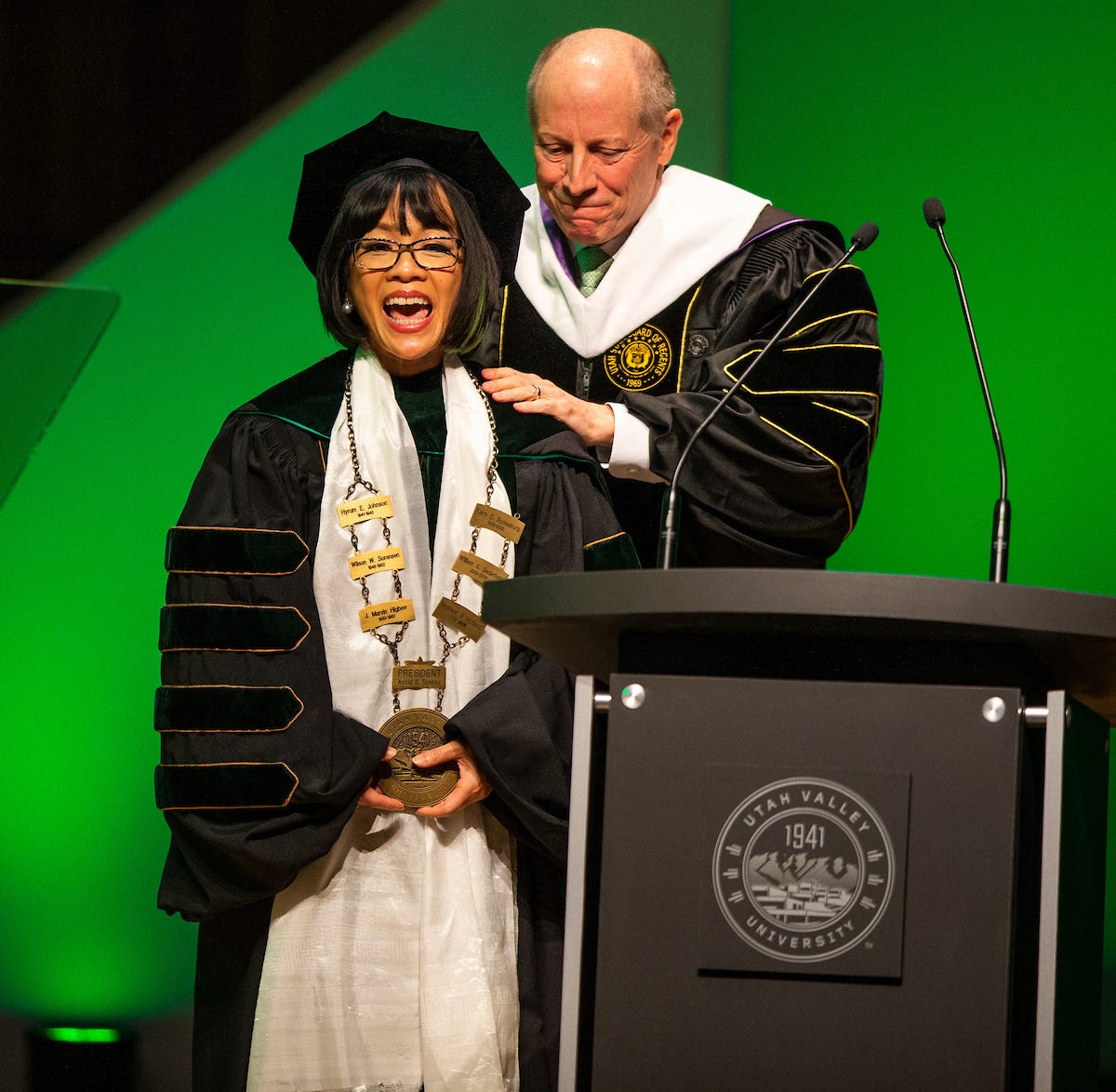
On November 24, 2025, I called on Utah senators, congressmen, and education officials to fire and investigate Utah Valley University (UVU) President Astrid Tuminez and her henchwomen—assistant Provost Kat Brown, biology professor Sara Flood, and former UVU general counsel Karen Clemes—for their well-documented abuses of power at the university. In 2019, my nonprofit, Fainting Robin Foundation, was asked to investigate UVU’s star chamber trial of anatomy professor Michael Shively. It was the most biased, one-sided, and unprofessional investigation I have read in my thirty years as a professor, college trustee, and legal investigator. Much worse, I believe that the Tuminez tribunal drove Michael Shively to suicide.
After I published my findings in 2022, the professor’s widow sued Astrid Tuminez and others for her husband’s wrongful death in Ann Shively v. Utah Valley University, Astrid S. Tuminez, Karen Clemes, and Sara J. Flood. The issue of due process was at the heart of the case. Although I was disappointed when the 10th Circuit Court of Appeals affirmed the decision that Utah’s Governmental Immunity Act barred wrongful-death claims against UVU and its employees, it hardly exonerated the defendants.
Equally disappointing was The Chronicle of Higher Education’s strangely ambivalent article, “Was This Professor Dangerous? After 26 years in the classroom, a professor was pushed out. Was he a legitimate threat, or just tough?” The Chronicle’s senior correspondent, Emma Petit, failed to mention that Astrid Tuminez’s nephew, a UVU student in 2019, played an important role in this investigation. Identified only as “Student 1” in the university’s redacted final report, the president’s nephew was the self-described “unofficial spokesperson for a growing group of disaffected [Shively] students.” Most surprising, he had never been Michael Shively’s student.
After “Was This Professor Dangerous?” was published, I sent this letter to The Chronicle of Higher Education: “Conspicuously absent from Emma Petit’s 2020 article ‘Was This Professor Dangerous’ is the fact that Michael Shively’s chief accuser was the nephew of Astrid Tuminez, the President of Utah Valley University. In a recent episode of Insider Exclusive‘s ‘Justice in America: Dr. Michael Jay Shively’s story’ UVU professor James Harris stated: ‘I was a little bit shocked by the aggressiveness of one of the student accusers who was the ringleader and happened to be a nephew of the President of the institution. I don’t think anyone else would have gotten that attention....That’s the remarkable thing, he wasn’t even one of Mike’s students. He was in a different class, but was the ringleader, getting students to complain and organizing this whole thing. A very aggressive individual.’ This fact has been confirmed to me by several other people in the UVU community who do not want to be identified for fear of retribution. I am not sure how Ms. Petit could have missed this widely known fact.” The Chronicle of Higher Education, a publication that proclaims integrity to be their “North Star,” did not publish my letter.
In 2022, after UVU prevailed over the Shively family in court, I emailed Astrid Tuminez, Kat Brown, and Sara Flood several times each and asked them a simple question, “Now that the Shively case is over and UVU won, will you confirm that [sic.] fact that ‘Student 1’ was Astrid Tuminez’s nephew?” Not one of them replied to my emails, but in 2025 an anonymous source sent me the 2019 email thread between “Student 1,” Jason ####, and the UVU biology department. Using open sources, I was able to determine that Student 1 is the son of Astrid Tuminez’s sister.
As I wrote in my letters to the senators, “There is much to admire about Astrid Tuminez’s rise from Philippine poverty to the C-Suite at Microsoft, then to the presidency of Utah Valley University (UVU).” I have no ill will towards Astrid Tuminez, but we disagree fundamentally on education. I believe that teaching is an art, not a science. I do not see students as customers and do not believe that knowledge and learning are only commodities to be monetized.
Astrid Tuminez described the “old model of academia” as “snobbery” after she took power at UVU in 2019. As a member of academia’s new managerial elite, the former Microsoft executive applied Big Tech’s “Move fast and break things” model to her university. She explained to a reporter, “the new test is whether you can make it in the workplace, and whether you know how to get stuff done.” According to this new paradigm, students’ “success” and “comfort” became as high a priority as their education. Professors were now afforded neither. More ominously, as the Shively case demonstrated, due process protections no longer extended to the academic help.
Under Tuminez, UVU’s graduation rates and fundraising campaigns reached record highs. Faculty morale, however, plummeted. “Shortly after the current president (Astrid Tuminez) was inaugurated in 2019, the university started to make changes to increase its graduation rate by watering down the curriculum and lowering standards,” wrote psychologist Russell Warne, in a letter explaining why he resigned from his tenured position at the university. “UVU, students are being treated more like customers who must be mollified and coddled. The respect that the administration shows towards the faculty has decreased proportionately.”
When Astrid Tuminez took over at UVU in 2019, she told an interviewer that “the core values of her model center around care, accountability and results.” With new legal cases against her on the horizon and more evidence of her abuse of power, the time has come to hold her accountable. For Utah Valley University to restore its institutional integrity, Astrid Tuminez should be fired. She and her minions Brown, Flood, and Clemes, need to answer a simple question: did they conspire with Jason #### to purge Michael Shively from UVU?
Below is the 2019 email chain that I received in 2025 and my letter to the Senators, Congressman, and other Utah officials. They received an unredacted version.
From: Jim Price
Subject: Fwd: Follow up to Friday’s meeting
Date: March 5, 2019 at 11:42 AM
To: ####@uvu.edu
####,
Here is my message to ####, ####, and ####, to let them know that I did not know how to handle this student and seek their advice on referral.
Thank you again for your help.
Jim
Jim Price
Biology Department Chair
Utah Valley University MC 299
801-863-7447
####@uvu.edu
Begin forwarded message:
From: James Price <####@uvu.edu>
Subject: Re: Follow up to Friday’s meeting
Date: March 3, 2019 at 7<49<46 PM MST
To: ####@uvu.edu>, ####@uvu.edu>, ####@uvu.edu>
####, ####, ####
The student who sent the message below came to my office at 4:30 Friday afternoon and stayed until after 5 pm. He left of his own accord because he needed to go somewhere. I gave him all the time he wanted and spoke to him frankly and respectfully. However, it was apparent then and more apparent now that he has a chip on his shoulder. He came to complain about Shively, but he is not Shively’s student. He is unhappy that Shively wrote an exam that was used in both his and Sara’s classes (Sara is planning to write the next one). He told me that Shively was arrogant and does not care about his students. He also claimed that all of the faculty hate Shively and that we have a dysfunctional department (a claim he repeats below). I did assure him that Shively gets along fine with the rest of the department. I do not know where that is coming from.
When he left I told him I would ponder our conversation and I have been doing so, but I did not expect him to become angry. What I have been pondering is Shively’s pedagogy and how I could help him understand the benefits of the way we teach anatomy. His message below sounds angry and defiant on several levels and he seems to be claiming a great deal of authority.
His list is much longer now than it was on Friday afternoon. What started out as a complaint that Mike’s exams are too hard has expanded into a list. I have the impression that anything I say will just be added on to the list. He is now asking for proof that our Anatomy class best serves the students, but I doubt if he would accept any evidence we offer. He is also threatening to go to the equity office about “the transphobic language found on page 502 of the textbook (third paragraph)”. That was not part of our discussion yesterday. Of course he is welcome to go to the equity office, but I believe it has already been noted and that Mike is in some negotiation with #### to have it corrected. What bothers me is that the student seems to be presenting it as a threat.
I don’t know how to deal with this student and I would prefer not too. I would like to refer him to one of you if anyone is willing to take him. He states that his plan is to bring his concerns on up the ladder anyway.
I would add that #### tells me that the student claims to be the nephew of President Tuminez and that may be true. I would hope that would not make any difference in the way we handle him, as I said I felt we had a respectful conversation. However his relationship to the president may give him some reason to believe he has more authority that most students.
In the message below he has distorted a number of things and taken many out of context. He never asked for confidentiality, he did not have a specific complaint about a specific person (except his belief that Shively is arrogant, which I did not register as a complaint, just an opinion). Yet he claims that I violated confidentiality. Rather his complaint which I did not register as a complaint, just an opinion). Yet he claims that I violated confidentiality. Rather his complaint was about the difficulty of the exams. (Students know the scores are all normalized to 75, so the raw average should not matter). He did attribute comments about the difficulty of our anatomy classes to #### and I asked #### what he had told the student.
I have not responded to his message yet and I do not plan to until I get some advice. If I do respond, I have been taught that I should set the record straight, but he has made so many misleading assertions I really don’t want to take the time to address each of them. Some are kind of crazy. I never said I was right, I said I had considered the difficulty of Shivley’s class and his exams and talked it over extensively with people who knew anatomy better than I. That I had discussed it with trusted advisors and based on those discussions I feel that it is a very good program.
Sincerely,
Jim Price
On Mar 3, 2019, at 4:30 PM, Jason ####@my.uvu.edu> wrote:
Dear Dr. Price,
I’m writing this email as the next step in our conversation following Friday’s meeting which, I am sure, was unsatisfactory to both of us. As a starting point let me say that I learned my lesson about expecting anything I tell you to be held in confidence. #### politely asked that I not mention his name in any further administration meetings. He didn’t mention any of the details of your meeting, but I can guess at the details. I understand you’re a man with power in your department. There’s no need to pull third parties into a private complaint. I feel intimidated enough about my own academic future and the effect you might have it should you feel sufficiently aggrieved by my concerns, but feel compelled to air them nevertheless. My concerns, which I apologize for not expressing more concisely and dispassionately earlier, are as follows:
1) By using the words “Your generation....” and musing, “Maybe your generation is more anxious,” you attempted to dismiss my criticisms as mere Millennial entitlement. As I made clear, I’m 36, have two master’s degrees, and spent the last 10 years teaching in America and abroad. I’m not some mewling, doe-eyed Millennial--if such a creature actually exists--and resent the implication thoroughly. I think one of the fundamental problems in modern education is the misunderstandings between the generations. As someone who has chosen to work with Millennials I would suggest it is incumbent upon you to listen to and understand them since you aren’t going to force them into the educational mold that worked for the baby boomers. Whether you feel like a complaint is legitimate or not, dismissing it as Millennialism is demeaning and unprofessional.
2) As to the recent test, I took an informal poll, and I fully encourage you to do the same. Among the 20 students I talked to, not one correctly identified “to encourage critical reading skills” as the general purpose of the test. I received several “I don’t know” responses, a few joking “to make us hate ourselves,” and more than one “because Shively wants us all to know how smart he is” answers. Concerning the last, I was told in his lecture that Shively bragged about how the test was maybe the most difficult he had ever written and that he himself wouldn’t be able to answer all the questions correctly. Whether you want to admit it or not there is such a thing as a test that is too hard. Difficulty, as I’m sure you are aware, is simply one assessment tool among many and it’s a poor pedagogue who uses it for its own sake. If you want to make a test so hard that the average is a 35% that’s fine. However, it still has to be clear to the students that it is making them better health practitioners, which clearly is not happening. As much as you would like to blame every problem on the students, the program does bear some responsibility for whether or not learning outcomes are reached. This leads to my third point.
3) The administration has not earned sufficient buy-in from the students. It seems to me as though the administration wants it both ways. They want to make a course that is extremely difficult and rigorous, but at the same time they want the students to passively accept it. Any complaint is met with a “Here we go again...” exasperation as though it is surprising that people would have concerns about a single class which often takes 70% or more of a student’s academic focus. You want to be able to brag that you’ve set a higher bar than any other school in Utah? Fine, but it is your responsibility to get students on board in order to forestall complaints and to do some of the work of preparing students for the mental and material hardships the class will entail.
4) My final point, and the point which led me to your office in the first place, is that it has not been adequately proven to me that the anatomy program best serves the students at UVU. In spite of its golden reputation in the administration’s eyes, by making the course as difficult as it is you are going to burn students out who would be better off not being burned out, and exclude students from advancing to the next level who would make perfectly fine healthcare practitioners. Since you seem to like anecdotal evidence in support of the class, here’s one from the opposite side of the argument. A nurse I work with received a C- in Shively’s class. She retook anatomy at SLCC, got an A, passed the NCLEX with 75 questions, which is incredible, and, last week, saved a patient’s life in spite of an A, passed the NCLEX with 75 questions, which is incredible, and, last week, saved a patient’s life in spite of sudden, unexpected equipment difficulties. She has nothing but disdain for Shively and for UVU anatomy. As convenient as it would be for you to pretend that such students don’t exist, they do. Once again, it is incumbent upon the university to prove that putting students like her through the wringer, adding to their emotional burdens and financial stresses by pushing them out or forcing them to the class elsewhere, making life that much more miserable for those who have to work to put themselves through school or who have children and spouses they barely see for months, is all worth it because the doctors and dental hygienists that UVU produces are THAT much better than someone who took anatomy at the University of Utah. Can you honestly make that utilitarian argument? Are you that certain of your righteousness?
Based on our last conversation I don’t expect these questions to be of much concern to you. You seem to know you’re right, and maybe you are. Maybe what you are reading is simply the whinging of another entitled Millennial who doesn’t understand that father knows best, and maybe I’ll be thanking you two years from now for the burdens the program impressed upon me. I do find it ironic that you kept plaintively asking “What do you want me to do about it?” in a plea for sympathy when, to echo your dental hygienist friend, who didn’t go through the program, and who somehow believes that learning the tendon insertion for the big toe is relevant to her profession, the words “no sympathy” were at the core of your discourse. What did I want you to do? I wanted you to listen. Since you appear unwilling or unable to do so, I will be taking the concerns I’ve listed above to the dean and, from there, to whoever comes next in the administration.
All the same, and in spite of how this email may come across, I do sympathize with you. You have been tasked with defending a grueling program to a student population of which you don’t appear to have a clear understanding. At the same time, you are forced to hold together as best you can the disparate threads of a clearly dysfunctional department, and the political intrigues surrounding someone who is a personal friend. I don’t envy your task. Nevertheless, whether you will or not, it’s your responsibility to say something to the students. Given my age and experience I have become something of an unofficial spokesperson for a growing group of disaffected students. They want me start a petition. They want me to take the transphobic language found on page 502 of the textbook (third paragraph) to the Title IX Office. What do you want me to say to them? This is your chance.
Regards,
Jason ####
My letter to Senator John Curtis:
November 24, 2025
Dear Senator Curtis:
My name is Dr. Peter Maguire. I am the founder and director of Fainting Robin Foundation. In 2019, I was asked to look into Utah Valley University’s investigation of anatomy professor Michael Shively. It is, by far, the most biased, one-sided, and unprofessional investigation I have read in my thirty years as a professor, college trustee and legal investigator.
There is much to admire about Astrid Tuminez’s rise from Philippine poverty to the C-Suite at Microsoft, then to the presidency of Utah Valley University (UVU). However, given her well-documented abuse of power at UVU, she has forfeited the right to lead this, or any other university, ever again. She will be best remembered for the Tuminez Tribunal—the academic star chamber court she established in 2019 to make an example of UVU anatomy professor Michael Shively. Her tribunal did not just end with its prearranged verdict; it ended with the suicide of UVU’s five-time teacher of the year that was a direct result of his traumatic, public ostracism. Although the 10th Circuit Court of Appeals affirmed the Utah District Court’s decision in Ann Shively v. Utah Valley University et al, it hardly exonerated defendants Astrid S. Tuminez, Karen Clemes, and Sara J. Flood.1
The Tuminez Tribunal was convened at the behest of UVU student Jason ####. Identified only as “Student 1” in the investigation’s final report, Ludlow was the self-described “unofficial spokesperson for a growing group of disaffected [Shively] students.” Although Jason #### was never Michael Shively’s student, he was Astrid Tuminez’s nephew, a fact he made ominously clear to the members of the UVU faculty. #### showed up unannounced at UVU biology professor Jim Price’s office, and implored Price to investigate Michael Shively. Price wrote: “What bothers me is that the student seems to be presenting it as a threat. I don’t know how to deal with this student and I would prefer not too [sic]. I would like to refer him to one of you if anyone is willing to take him. He states that his plan is to bring his concerns on up the ladder anyway. I would add that #### tells me that the student claims to be the nephew of President Tuminez and that may be true. I would hope that would not make any difference in the way we handle him, as I said I felt we had a respectful conversation. However his relationship to the president may give him some reason to believe he has more authority that most students.”2
When I was writing my 2021 article, “The Red Queen’s Rules,” multiple sources told me, off the record, that “Student 1” was Tuminez’s nephew. Only one person, Professor Jim Harris, was willing to go on the record. The rest refused because they were afraid of reprisals and professional retaliation by Tuminez and her adjuncts.2In 2025, an anonymous source sent me the 2019 email thread between Jason #### (“Student 1”) and the UVU biology department that would grow into the Tuminez Tribunal.
Using open sources, I was able to determine that Student 1, Jason ####, is the son of Astrid Tuminez’s sister, ####. The obituary of Astrid Tuminez’s mother, ####, names all her children: “#### is survived by eight children: ####, ####, ####, ####, ####, ####, Astrid Tuminez, and Julie ####. She is also honored by 25 grandchildren and soon-to-be 27 great-grandchildren.” According to the website My Life, Julie #### was born on #### and “her family members include….Jason #### [same last name].” Jason #### was born ####. Both he and Julie #### once shared the address: 824 #### Ct., Las Vegas, Nevada.3
In addition to terminating Astrid Tuminez’s tenure as president, UVU assistant provost Kathren Brown, biology professor Sara Flood, and former general counsel Karen Clemes should all be forced to answer a simple question: did they conspire with Jason #### to purge Michael Shively from UVU? I have also forwarded hard copies of this letter and supporting material to UVU trustees, the Faculty Senate, Senator Mike Lee and Congressman Mike Kennedy. Please do not hesitate to contact me if you have any questions about the tragic case of Michael Shively.
Respectfully,
Dr. Peter Maguire
1 https://petermaguire.substack.com/p/the-red-queens-rules-207
2 Jim Price email to #### et al, March 3, 2019.
2 https://petermaguire.substack.com/p/the-red-queens-rules
3 ####