Unconditional Surrender?
Hell no! Our sons won't go!
“They seem indeed to accept the situation, and admit that they have been beaten, bow to superior force, and bury the hatchet til a good chance comes of paying off the score.”
—British General Aylmer L. Haldane, Insurrection in Mesopotamia (1922)
President Trump’s call for an “UNCONDITIONAL SURRENDER” and an American-led reconstruction of Iran makes me long for Iraq at the height of the insurgency in 2007. Perhaps Elbridge Colby, the Netanyahu/Trump junta’s resident intellectual, can inform the president that prerequisites for an unconditional surrender include a decisive military victory and an occupation that results in a monopoly on military force. Yesterday, I spoke to my draft-age sons (eighteen and twenty), and we are in heated agreement that, draft or not, they will not serve in America’s latest imperial war.
Nation building in Iran, a country almost four times the size of Iraq (636,000 square miles; Iraq 169,000 square miles), will require hundreds of thousands of American boots on the ground. In 2003, the U.S. military appeared to overthrow Saddam Hussein in little over a month, but by 2007, a U.S.-led coalition of 300,000 soldiers and mercenaries was mired in an unsuccessful counterinsurgency war in Mesopotamia. After America’s ignominious exit from Iraq in 2011, ISIS and radical others quickly filled the power vacuum, and today that nation remains politically unstable and increasingly volatile. Although 4,500 Americans died in Iraq and another 32,000 were wounded, no Bushs, Cheneys, Netanyahus, Obamas, Clintons, or Trumps were among the casualties.
From 2006–2015 I worked as a defense contractor with the Master Chiefs, Sergeants and Captains who spent the best years of their youth fighting Muslims in Iraq and Afghanistan. Like many other brave, young, patriotic Americans, eighteen-year-old Neal Zumbro enlisted in the Marines in 2001 to defend his country. He crossed the border into Iraq on March 21, 2003. His battalion (2/8) was part of Task Force Tarawa. He headed towards Al-Naseriyah in the back of an unarmored truck, and Zumbro saw muzzle flashes in the desert. As incoming rounds whizzed overhead, he took aim, and just as he was preparing to pull the trigger for the first time in combat, the sand bag near his head exploded in his face and knocked him on his back. “It felt like a punch,” recalled Zumbro. “I thought I was hit because all the sand flew in my face. I was almost KIA in opening moments of the war but a miss is a miss! I popped back up and returned fire instantly.”
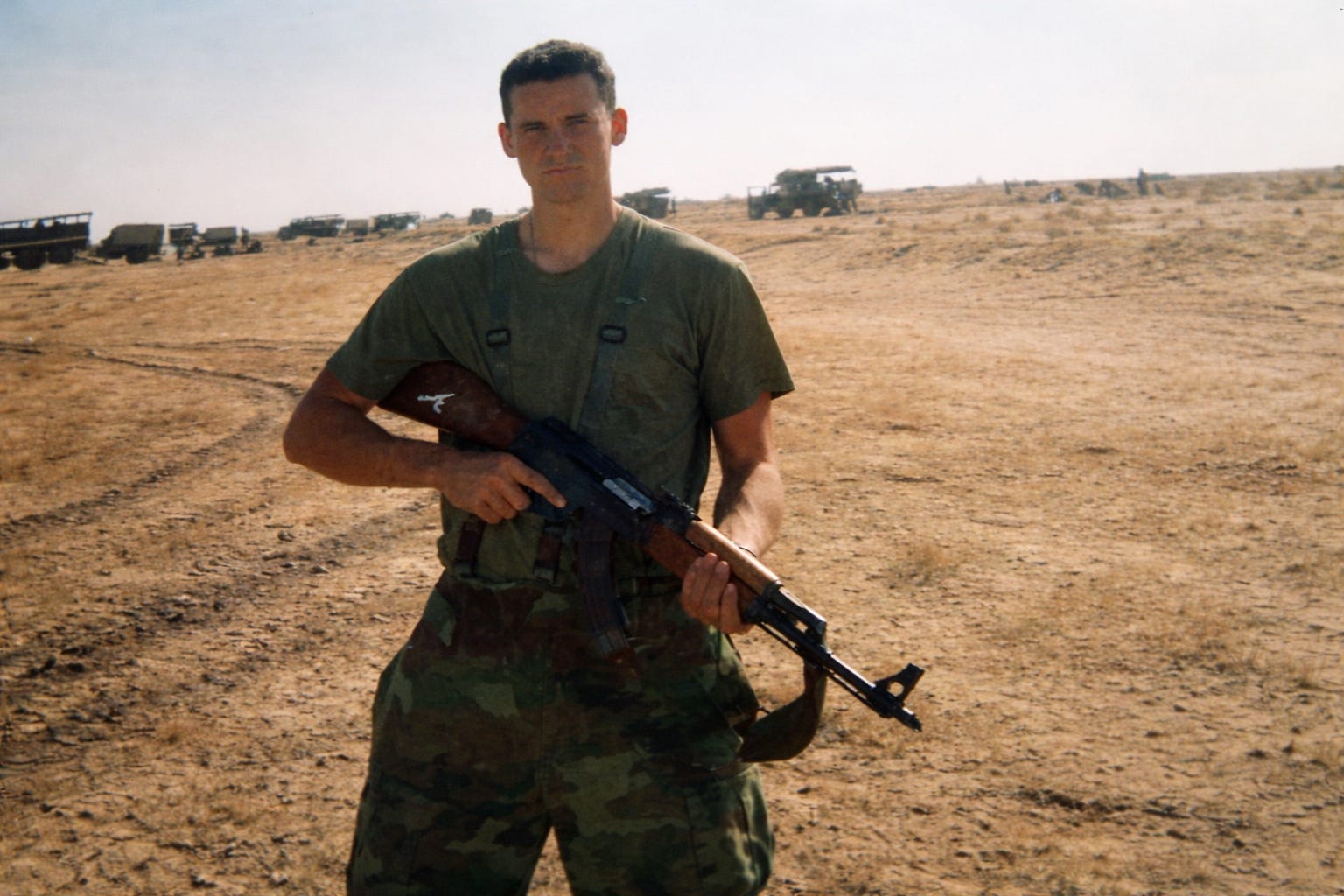
Zumbro’s next tour was in Afghanistan where he spent six long, winter months (two months without a shower) fighting skilled and seasoned insurgents in the mountains. When he returned to Iraq in 2005 for his third tour, he was now fighting the same Iraqis who had been his allies on his first tour. After Neal Zumbro’s four-year contract with the Marines ended in 2005, he moved to Wilmington, North Carolina, and began to make up for lost time.
Zumbro enrolled in college, learned to surf, fell in love, and began competing in Jiu Jitsu and MMA. He was living the dream until he was recalled for another tour of Iraq in 2008. Zumbro could have used his service-related injuries to avoid combat, but decided “my Marines need me.”
Now a staff sergeant, he returned to the Middle East as the leader of a machine gun section. In addition to six medium machine guns, he was also responsible for the lives of twenty-one young Marines. “This company would be hurting without him,” Zumbro’s commanding officer Captain Brian O’Shea told embedded New York Times reporter Eric Owles in 2008. When the reporter asked Zumbro what “he honestly thought about Iraq’s prospects,” his candid response stunned Owles (and the Commandant of the Marines). “I wonder if it was worth it,” said Zumbro. “Everything we’ve done. Everything we got out of it.” As Owles wrote down his answer, he asked the Marine if he was worried about saying something so controversial. “I feel like I deserve to say what I want,” Zumbro replied. “In Afghanistan there is a legitimate threat. Here it’s a civil war.”
In 2010, I met Neal Zumbro at a Jiu Jitsu academy in Wrightsville Beach. The best fighter in the school, the twenty-six-year-old veteran with long, wild hair appeared to be an easy going surfer. However, it was clear to me that he had been touched by fire and sometimes struggled with the dull monotony of civilian life. One day, I went to train with Zumbro and was surprised to see that he had shorn off his distinctive locks. He told me that he would not be able to train for a week or two because he had to travel all over America to attend funerals. Although he had gotten all of “his Marines” home safely from Iraq, after his retirement his battalion returned to Afghanistan where one of their vehicles hit an IED and five of his comrades were killed. Zumbro planned to lay his sun-bleached curls at the grave of a Marine who had looked forward to growing his hair long after he left the military.
Neal Zumbro is now married with two sons and owns a successful tree trimming business. Yesterday, we discussed this war, and he also agreed that his sons, like Barron Trump and Yair Netanyahu, will not serve in Iran. We also agreed that because America’s bought-and-paid-for politicians and Pravda-like press were failing so badly, we would travel to Washington, D.C. together to protest Trump and Netanyahu’s undefined and rapidly widening and escalating war. For the first time in our lives, we will both join the anti-war effort. However, this protest movement will not be led by women in pink hats, Thousand Currents, or Alex Soros’s shadowy shock troops. It will be led by men like Neal Zumbro who were touched by fire.